

Images courtesy of Focus Features
THE UPRISING— 4 STARS
Any time a historical conflict gets the dramatized big-screen treatment, as England’s Peasants’ Revolt does in director Paul Greengrass’s new film The Uprising, there are customary checkboxes that come with casting, production design, and other stylistic choices that turn into plenty of nitpicky pluses and minuses for folks to critique. One aspect, above all, that absolutely must translate from the academic record to a feature film is the motivation or reason for the selected strife, even as movies will always be cherry-picked and condensed in their narrative structure. Twist those roots or misrepresent them, and a large measure of respect and credibility is immediately lost.
LESSON #1: DO YOUR HISTORY HOMEWORK— For those thin on their later Middle Ages history, the Peasants’ Revolt of 1381 was a several-month-long period of violent upheaval in large sections of the kingdom led by Hundred Years’ War veteran Wat Tyler and the radical Lollard priest John Ball. It peaked with the sacking of the Tower of London and a mass execution of royal officials—with heads paraded in the streets and placed on London Bridge, no less—on June 14, 1381. This conflict occurred during the young teenage years of the reign of King Richard II, who would earn dubious prominence for his brutal suppression of the movement, all 200 years before William Shakespeare would fictionally chronicle his life in his famous play, The Life and Death of King Richard the Second.
LESSON #2: WHY DID THEY FIGHT FOR?— That’s the thumbnail primer, but what truly counts in The Uprising is, again, what folks fought for. The Peasants’ Revolt stemmed from economic and societal hardship in the wake of the Black Death plague and ongoing costs of the Hundred Years’ War waged in France. The pandemic wiped out 30-60% of the European population at the time, leading to both broken families and a drastic reduction of the tax-paying civilian workforce. With the rapid inflation, much of the financial burden of maintaining the war chest and the comfortable noble lifestyles above them fell on the poorest of people. By 1381, the oppressive taxation and the unfair operation of serfdom reached its boiling point of pushback.
Now, if you read those last two paragraphs with either boredom, uneasiness, or, hopefully, the flicker of sensing similarity between the chosen past and the turbulent present, know right away that The Uprising was always in good hands with Paul Greengrass, a former English Lit major at Queen’s College in Cambridge and a frequently fervent storyteller on film who is never shy about violence, extremism, or the ugly truths behind even uglier history. This man nails and champions the proper characterization of the overarching cause and, with his filmmaking prowess for scope and tension, delivers a bracing experience that rattles ancestors and descendants alike.
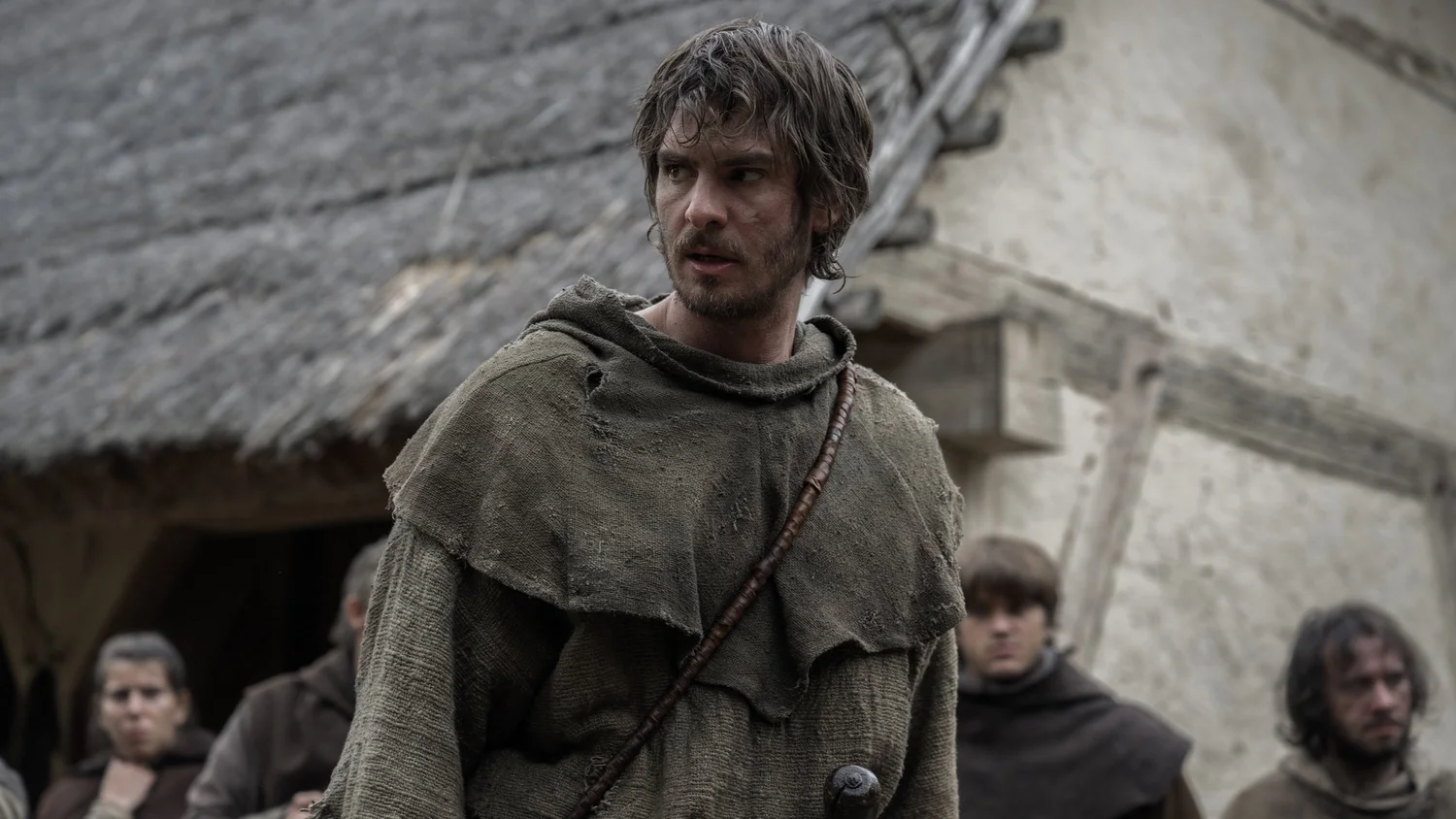
For The Uprising, Greengrass funnels the historical events of the Peasants’ Revolt through an unnamed marshland farmer, played by headlining Oscar nominee Andrew Garfield. Given the name “Ploughman” to match his meek profession (and as a likely nod to William Langland’s celebrated poem Piers Plowman from the same era), he cannot produce the funds to pay the death taxes for his Plague-lost wife and child. That penalty, coupled with the horror of watching officials sexually assault his village’s young women to crudely prove their child-bearing readiness, leads him to turn his sickle from a tool into a weapon in a skirmish that starts a domino effect across the region. Plougman’s story, surged by the survivors’ grief shared by so many affected by the Black Death, stirs sympathy and gains a growing horde of commoners, shepherded by the impassioned priest John Ball (Jamie Bell of All of Us Strangers) and the stoic war veteran Wat Tyler (Warfare’s Cosmo Jarvis) acting as the larger mouthpieces, to march on London to plead their case before King Richard II (C’mon C’mon breakout teen actor Woody Norman), his mother—the Joan of Kent (Katherine Waterson of Inherent Vice), and his ever-present court.
LESSON #3: THE POWER OF PETITION— The Uprising occupies a precarious pendulum between positive intent and negative consequences. The optimistic side of that balance rests in the power of petition. As angry as the citizens are at the state of things, they are coming to London—singing in harmonious unison at several points as a huge, walking crowd of assembled extras in sweeping transition scenes captured by The Lost Bus cinematographer Pål Ulvik Rokseth—in good faith with earnest hopes of mercy and clemency. They still believe in their King, even if he is being steered by an inner circle of “we dirty our hands to keep yours clean” traitorous advisors, including the Bishop of London, Simon Sudbury (Game of Thrones regular Stephen Dillane) and Lord High Treasurer and Admiral of the West, Sir Robert Hales (professional movie villain Tom Hollander).
LESSON #4: THE EFFECT OF UNQUENCHED RAGE— That said, The Uprising’s downtrodden know their quarry of Sudbury and Hales and have amassed a force of torches and pitchforks larger than the Mayor of London, Sir William Walworth (Trainspotting’s Jonny Lee Miller), his small militia, and an absent army overseas can quell. If good faith is broken and walls and bridges are breached, ensuing rage will be used to gain freedom instead of temperance. True to history, Paul Greengrass reenacts that very result in fiery, grand, and sanguinary fashion. Now that blood has been spilled, and luxury has been soiled, the tipping point becomes the crowd’s satiation versus an untested new king’s idea of rule or peace.
LESSON #5: “ALL WILL BE WELL WHEN THE POISON OF WEALTH IS REMOVED”— Thanks to that prophetic line, it’s no accident or coincidence that The Uprising’s events feel like a stark reminder of George Santayana’s immortal quote from 1905’s The Life of Reason: “Those who cannot remember the past are condemned to repeat it.” With deep empathy and surging urgency, Paul Greengrass issues a call for justice and an end to the exploitation of the poor through this compelling and comparable chapter of history. Beginning and ending thematically with royalty experiencing stormy nightmares at the thought of civil mutiny, the parallels are striking and should, chiefly, be the strongest topic of conversation and inspiration coming out of this movie.
Unfortunately, those powerful and universal principles which need modern-day reminders might not be the case for the immediate and long-term legacy of The Uprising, thanks to one enormous swerve orchestrated by Greengrass. Taking a hop, skip, and a jump from the 1381 Peasants’ Revolt and the name-dropped homage to Langland, The Uprising is posited as a springboard origin story to the Robin Hood legend through Garfield’s character morphing from a mourning man of benevolence and torment to an emboldened leader of advocacy and vigilantism. While a bearded and facial-scarred Andrew Garfield, in a heavy period role, firmly proves he has the soul and energy for this type of material, with poignant displays of both his challenged heart and combative hands, this mythic injection is a risky one, especially with a story that’s been done dozens and dozens of ways. The overall approach counts as unique, but it may overshadow the greater lessons and failed miracles that need to be told instead.
LOGO DESIGNED BY MEENTS ILLUSTRATED (#1428)