

Images courtesy of Burns and Co.
JIMMY— 3 STARS
If all James Stewart ever did was act in movies, he would still be the icon the world fondly remembers to this day. His film resume is filled with bona fide hits and all-time performances. A movie like Jimmy could recreate those highlights for two hours, and audiences would welcome the show—and likely forgive mild caricature—if it meant snuggling up to that famous droll and some of his well-worn stories. But there was more to the Pennsylvania native and a motivation of greater purpose than what was projected on the silver screen.
Right after winning an Oscar, James Stewart, at the age of 33, put his career on hold to enlist as a pilot for the U.S. Army Air Forces in 1941, months before the attack on Pearl Harbor would thrust the United States of America into World War II. Broaching that decision with modern eyes, imagine the presently 33-year-old David Corenswet giving up his current career trajectory, gilded by playing Superman last summer, to join the military. Even if we come to respect one’s personal convictions, plenty would call him crazy. What kind of person would do that? They are certainly rare, and Jimmy presents that exact type.
LESSON #1: THE EPITOME OF “THE GREATEST GENERATION”— Matching the thematic discourse of retired journalist Tom Brokaw’s well-regarded 1998 bestseller, James Stewart was a member of “the greatest generation,” a unique era of Americans shaped by the Great Depression who composed the majority of the fighting men and women of World War II, and would become the parents to the Baby Boomers. Brokaw posited that those individuals participated in those efforts because it was the honorable or “right thing to do” over fame and fortune. That urgency made Jimmy Stewart tick. With Jimmy, the Birthright Outlaw writing and directing partners of Justin Strawhand and Aaron Burns have chosen to spotlight Stewart’s war years to cement the lionized virtues.
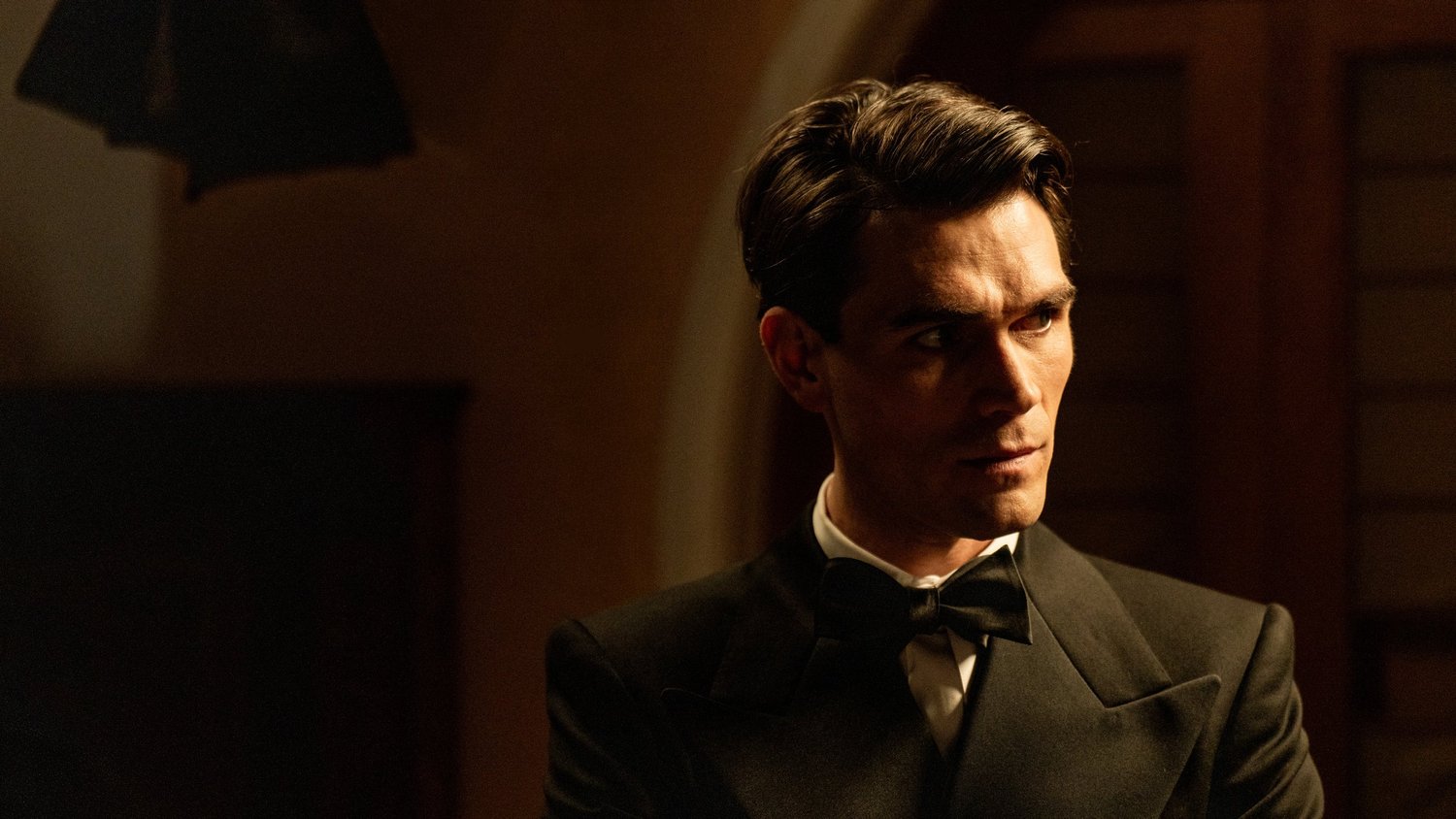
Clutching the Academy Award for Best Actor for The Philadelphia Story—a must-see romantic comedy if you’ve never seen it—and enjoying the glow of actress Ginger Rogers (fetching British TV actress Jemma Donovan) on his arm, James Stewart, played by former Riverdale star KJ Apa, has lassoed his Hollywood dreams after growing up in the small town of Indiana, Pennsylvania and tending the general store of his World War I veteran father, Alexander Stewart (professional “that guy” character actor Neil McDonough). All eyes, including those of his contract-holding producer Louis B. Mayer (Seinfeld’s Jason Alexander) at MGM Studios, gossip columnist Hedda Hopper (Sarah Drew of Grey’s Anatomy), and film director friend Frank Capra (longtime TV actor Max Casella), are on what Jimmy does next. That meteoric rise stops when Jimmy’s draft number is called, and he pushes away cold feet and industry pressure to report to the army.
At this point, Jimmy leaves Tinseltown behind and descends on Tibenham, England, where Stewart, a licensed civilian pilot, is now the captain of a B-24 Liberator, running missions across the North Sea to bomb key targets in Germany. Ascending to an officer’s position, Jimmy is enveloped by the responsibility and stress of making life-and-death decisions for himself, his crew, and the rest of the bomber group flying alongside him, including authoring the condolence letters that go home to families of those who don’t survive. These years put grey in his temples and trauma in his soul, lifted only by the respites that come from the non-fanboy camaraderie of his crew members (led by 2nd Lt. Martinez, played by Julian Works from 9-1-1: Lone Star and The Long Game) and the mindful, doting interest of a local patrician named Lady Julia Tyndall (Kara Killmer of Chicago Fire).
LESSON #2: FEELINGS AND FLAWS THAT THREATEN A GOOD MAN— As James tries to turn off the megawatt stardom and reputation he arrived with, his stoicism gains the one-of-us acceptance from his fellow soldiers, but it comes with a perceived moral price. Knowing the survivability odds and stakes as a leader, Jimmy often feels that he’s using his charisma and motivating gifts as an actor in pep talks to lie and fool others into dangerous missions and wavering causes of patriotism. That guilt adds to the festering PTSD of witnessing his fair share of crashes, casualties, and mounting losses. He relays these troubling feelings to Lady Julia, in some of Jimmy’s most poignant scenes of dialogue and meditative conversation, where Apa and Killmer shine with therapeutic bonding that outweighs the expected romantic interests.
Even as wartime victory relaxes the growing fears and pivots Jimmy to its third act, those sorrows would follow James Stewart home and back to his celebrity profession. Doubting the put-upon importance of profiting in entertainment again, James is torn on what new roles to take at this point in his life after seeing what he and other veterans have seen. This is when Capra, carrying his own war experiences, brings Jimmy the script and pitch for It’s a Wonderful Life. The filmmaker knows what James has gone through and wants that “earnest, dear, and courageous man” offscreen to be the George Bailey onscreen who wrestles with similar personal demons and seeks out the same hope the actor feels so strongly about. The rest, as many would say, is history.
Because Jimmy focuses on James Stewart’s time in the military first, there is inspiring strength to the movie’s abbreviation from a lengthy and tedious birth-to-death biographical journey. As aforementioned, a movie like this could have been all smiles, flashbulbs, and a golden tray of beautiful people and celebrity candy. To a degree, aesthetically, with its heavy use of hero lighting, manufactured magic-hour matte hues, and sweeping orchestral swirls from At Midnight composer Grant Fonda that seem to conveniently follow the protagonist indoors and out, there is a softening and safe glow to Jimmy even during the ugliness of war and the tame VFX used to create the flying and battle sequences. While there isn’t a missing need to go darker or harder with this subject, some audiences will wish for or prefer something edgier.
That said, Burns and Strawhand know the precise myth of prudence and gumption they are cultivating from the ashes of war instead of Hollywood palm trees in Jimmy. Following this less glamorous route, KJ Apa uses his impressive matches of vocal cadence and physical mannerisms to become a good, principled man who just happens to be Jimmy Stewart. His extraordinary performance—one carrying a ringing endorsement from James’s surviving daughter, Anne Stewart—is reason enough to salute Jimmy and admire the kind effort. That’s the stuff of legend and the proper core for a movie like this to celebrate.
LOGO DESIGNED BY MEENTS ILLUSTRATED (#1442)