
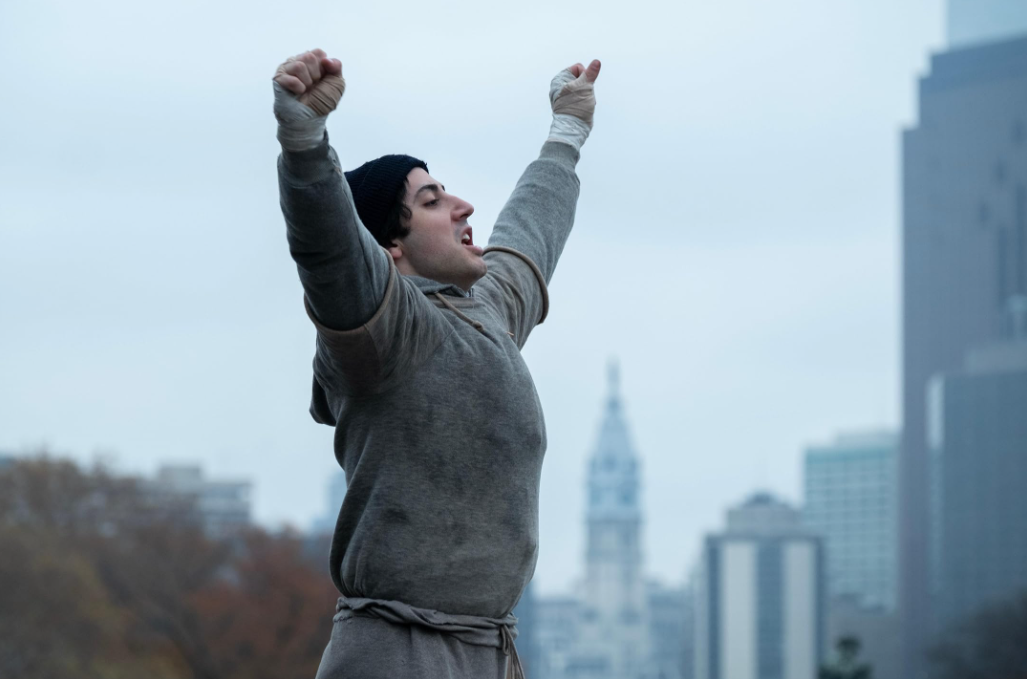

Images courtesy of Amazon MGM Studios
I PLAY ROCKY— 4 STARS
When it comes to rewatchable classics like Rocky, those movies have memorable high-point moments we cherish, which have been etched into our hearts and memories. Jukebox musical films and music biopics feed off this type of “greatest hits” energy too. Audiences, reveling in the familiar euphoria, sometimes want to think the behind-the-scenes efforts that made those iconic superstar moments or iconic songs were equally magical. I Play Rocky is a sharp and poignant example of that match not always being the case.
LESSON #1: MEMORABLE MOMENTS AT THE CREATIVE STAGE— Sometimes, just getting to the recording studio or scratching together the resources to even get to an independent film set for a camera roll was the more evocative journey than cranking out a would-be all-time hit or highlight. For all we know, those climaxes might have been the easiest or most nondescript days of work from the entire creative stage. Peter Farrelly’s film fleshes out that distinction between the stuff that was made to awe audiences and the underlying labor-of-love efforts others never knew or saw. Witnessing this side of the story as a semi-historical companion piece only makes one’s overall appreciation for all things Rocky and I Play Rocky grow.
With the supposed approval of Sylvester Stallone but not his involvement as a consultant or producer, I Play Rocky opens by recounting the star’s early days as a struggling actor under the stage name of “Mike” in New York City in the mid-1970s. Played with mirror-like emulation and chiseled respect by relative newcomer Anthony Ippolito, Sylvester chases casting calls and occasionally seedy uncredited roles for cash while adopting Butkus, the discarded bull mastiff pup, seeking the approval of his father, Frank (Matt Dillon, in an extended cameo), and wooing Sasha Czack (AnnaSophia Robb of Rebel Ridge and a long way grown up from Bridge to Terabithia and Soul Surfer), who would become his first wife. Soon, the newlywed couple moves to Los Angeles in hopes of improving their mutual careers and being closer to Sylvester’s Tinseltown dreams.
LESSON #2: WRITE YOUR OWN OPPORTUNITY— For a few years, all the scenery change in I Play Rocky amassed was more dead-end jobs and dwindling prospects of getting cast for anything viable. Looking to shake the “bum” and “goombah” labels—slurred voice grief included—he constantly receives from folks judging a book by its cover, Stallone becomes motivated to write his own foot-in-the-door by dabbling in screenwriting “since they’re never going to give him anything.” That effort is fostered further after getting connected to enterprising film producers Irwin Winkler (The Wolf of Wall Street’s P. J. Byrne) and Robert Chartoff (Toby Kebbell, returning to the big screen after expanding his resume on television), living off the Academy Award-nominated credibility of 1969’s They Shoot Horses, Don’t They? Little interest materializes from his first few scripts.
Inspired by watching the notable 1975 championship boxing match where heavy underdog Chuck Wepner took incumbent heavyweight champion Muhammad Ali 15 rounds before succumbing to a technical knockout, Sylvester finds his creative catalyst. In a three-and-a-half-day binge, he furiously writes the script for Rocky, pouring in personal parallels of his own life story distilled through the Rocky Balboa character and his perilous path towards finding love with Adrian Pennino and a date in the ring with the fictional champion Apollo Creed. Finally, Winkler and Chartoff feel the power of the story and Stallone’s work.
LESSON #3: THE ULTIMATE “BET ON YOURSELF” MOVE— The filmmakers and big-wig studio exec, Sandy Maddox (a composite character played by Tracy Letts, echoing his gatekeeper red ass role from Little Women), see gold and want to make a substantial offer to buy the script as a star vehicle for a bigger name like Ryan O’Neal, James Caan, or Burt Reynolds. Crazily, Stallone stands pat in the face of life-changing money with the titular reply of the film’s title, insisting the only deal he will accept is if he plays the lead role. Much of the second act of I Play Rocky is watching this “bet on yourself” move come to fruition under Stallone’s self-guiding principles of “If you don’t believe in yourself, how else are you going to get anyone to believe in you?” and “I’d rather be an optimist and be wrong than a pessimist and be right.” Those repeated, simple chestnuts glow well in the film.
From there, I Play Rocky leaps into many of the notoriously cut corners of the film’s turbulent all-hands-on-deck Philadelphia film production, made on the shoestring-of-a-shoestring’s budget and carrying the doomed expectancy of Sylvester’s failure. This is where Farrelly, the two-time Academy Award winner from Green Book, directing from an equally-from-obscurity script by feature first-timer Peter Gamble, presents a collection of those Rocky scenes we know and remember from different perspectives. Like the assertion of Rocky’s guerrilla director John G. Avildsen, played very strongly in the film by mumblecore gold standard and fellow film director Jay Duplass (The Baltimorons), the boxing is extremely secondary. In what may be a disappointing surprise to many, those looking for extensive duels between Anthony Ippolito and If Beale Street Could Talk’s Stephan James playing Carl Weathers are gazing past where other turning points occurred.
Calling back to Lesson #1, the highlights here in I Play Rocky are not from where you expect. While we’re still jogging through the streets amidst the citizen extras and ascending the towering outdoor steps of the Philadelphia Museum of Art, those shooting days, for example, were as much about proving the proficiency of the then-new Steadicam technology of cameraman Garrett Brown (played by working operator Michael Fuchs, getting to be in front of the camera for a change) and how that innovation saved the production a huge amount of money and time by the capability to film compactly in big and small locations, therefore skipping the tedious need for expensive dolly tracks or crane shots. In the same vein, I Play Rocky shows how the meat locker location almost got the production shut down by angry unions and how the pivotal ice rink courtship scene was almost cut for budgetary reasons. That unforgettable Bill Conti score we still blare at athletic events was a finishing touch added long after the cameras stopped rolling. Rather than borrow that, I Play Rocky lets the groovy soundtrack by Andrew Bird support its more meager ambience.
Little on-set victories like those—or domestic moments like putting pen to paper on a contract on a humble kitchen table instead of in front of magazine flashbulbs for the trades or having the money to buy back your trusty dog you sold when you were broke—are the fascinating developments that are made moving and important by I Play Rocky and its immersive insider point-of-view. The film’s one place where its own “Now we got it!” peak matches Rocky’s is watching Anthony Ippolito, as Sly, trying to find the right words and unscripted tone for Rocky Balboa’s angrily shouted monologue to Mickey. The inspirational sweep is built in the layers of knowing we’re watching the culmination of Sylvester’s own story, the core of Rocky’s story that embodies him, and now Anthony layer as a virtually unknown actor recreating it for respectful and motivational accuracy. When Ippolito brings “it” and nails that scene, just as Stallone did fifty years ago, the shockwave is a roaring announcement of talent. The 26-year-old deserves the Oscar nomination that is coming to him.
Even if dramatic license is inflating the true history in plenty of places into a tall tale fit for its own Hollywood movie—something suggested by Johnny Carson in 1976 to Sylvester Stallone on the late-night couch of The Tonight Show and presented after this film as a post-credits archival easter egg—the meta goal of weaving one legend out of another is tremendously successful. Living in the aura where Johnny said, “people wouldn’t believe it,” to which Stallone answered the ordeal as “blissful stupidity,” I Play Rocky finds its own poignancy and reverent specialness in bowing before the quintessential film business underdog story. Farrelly and company knew what they were doing. You’re going to come out of this movie primed and ready to watch the real thing, so go ahead and indulge in that adoration.
LOGO DESIGNED BY MEENTS ILLUSTRATED (#1448)