

Images courtesy of Sony Pictures.
THE SOCIAL RECKONING— 4 STARS
Sixteen years ago, nearly to the day, in this very review space, the biggest cited surprise about David Fincher’s The Social Network was how much the film wasn’t about Facebook. Focusing heavily on the history between founders Mark Zuckerberg and Eduardo Saverin, as brilliantly portrayed by Jesse Eisenberg and Andrew Garfield, it was a movie about the morally skewed people behind the wildfire beginnings and barely touched on society’s social networking behavior. Stewarded by returning and Oscar-winning screenwriter Aaron Sorkin ascending to the director’s chair, The Social Reckoning goes where The Social Network did not by bravely attempting to pull back a much taller, heavier, and scarier curtain that veils the tech behemoth’s controversial aims from the general public.
LESSON #1: THE EXPANSION OF AN EMPIRE— From the briefest of nuts-and-bolts functionality depicted in The Social Network, the loudest Eureka moment from a profile standpoint came from Mark Zuckerberg adding a “relationship status” section early on in the site’s existence. Now, as presented in The Social Reckoning’s recounted timespan between 2019 and 2022, we are shown astronomically greater depth. A billion-dollar company is now a trillion-dollar one that has taken over a chunk of its competition in WhatsApp and Instagram. What was millions of users is now billions. Minutes of casual checking have become hours of doomscrolling and self-inflicted indoctrination. In those distracted periods, users are steered by algorithms and ensnaring advertising towards what is supposed to be a hyper-connected and personalized experience. Such evolution shifted the darker corners of Facebook into a breeding ground of unfiltered and manipulative perspectives, which fanned the flames of hate speech, divisive politics, cyberbullying, and powder kegs of false internet courage. Aaron Sorkin, swinging both gently and bluntly, calls that dangerous milieu into question.
A composite of one of those malleable, transformed—though “gullible” is not far behind—users is the nameless woman that opens the film. A likely intoxicated and unhinged white woman (Mr. Robot cast member Porta Doubleday) standing oddly outside of her overheated car on the side of the road is shown spewing victimized rhetoric and ethnically charged threats at county sheriffs who pulled over to help. The bodycam video goes viral, and Facebook data engineer Frances Haugen (Anora Academy Award winner Mikey Madison) recognizes the woman as a former acquaintance who never used to be wired with that level of bias and outrage. The extreme personality change troubles Frances, leading her to deeply examine the spread of misinformation, especially the kind that flows unimpeded through reactions and reshares on her own company’s chief platform.
Taking the position as one of the co-leads of The Social Reckoning within those secretive walls as a member of Facebook’s Civic Integrity Team at their Menlo Park headquarters, Frances mines the data to see the decaying rot behind the gleaming corporate walls in 2019. When she attempts sidebars and suggestions for internal research into the matter, she is repeatedly ignored. Still believing in the company she works for but alarmed by the unchecked negligence and seeing herself more as the mythological Cassandra than Chicken Little, Haugen contacts newly reassigned Wall Street Journal reporter Jeff Horwitz (sternly focused two-time Emmy winner Jeremy Allen White) off-the-record with the hope and encouragement that his publication can conduct and publish the proper investigation. Echoing Lesson #1, nothing is simple or small anymore, and everything is as guarded as it is problematic.
LESSON #2: SOAK UP ALL THE JARGON— Either playing a Luddite for character trueness or for our own benefit as the guide for a TL;DR audience, Horwitz gets the scope of the massive problem explained to him (and therefore us) by Haugen in increasingly more lengthy and detailed meetings and exchanges over the course of several years. Filleted by Aaron Sorkin’s narrative knife for incisive and articulate dialogue, the tech jargon—like hyperuser, MSI (meaningful social interactions), and more—flushes much of The Social Reckoning. Some more affluent or cynical viewers might roll their eyes or furrow their eyebrows at having to soak up all of this tedious exposition and explanation. Others who enjoy Sorkin’s signature cadence and the slick injections of wit to break up the overbearing seriousness will gladly perk up their ears, sit up taller in their seats, and absorb all the information they can as a learning experience alongside Horwitz.
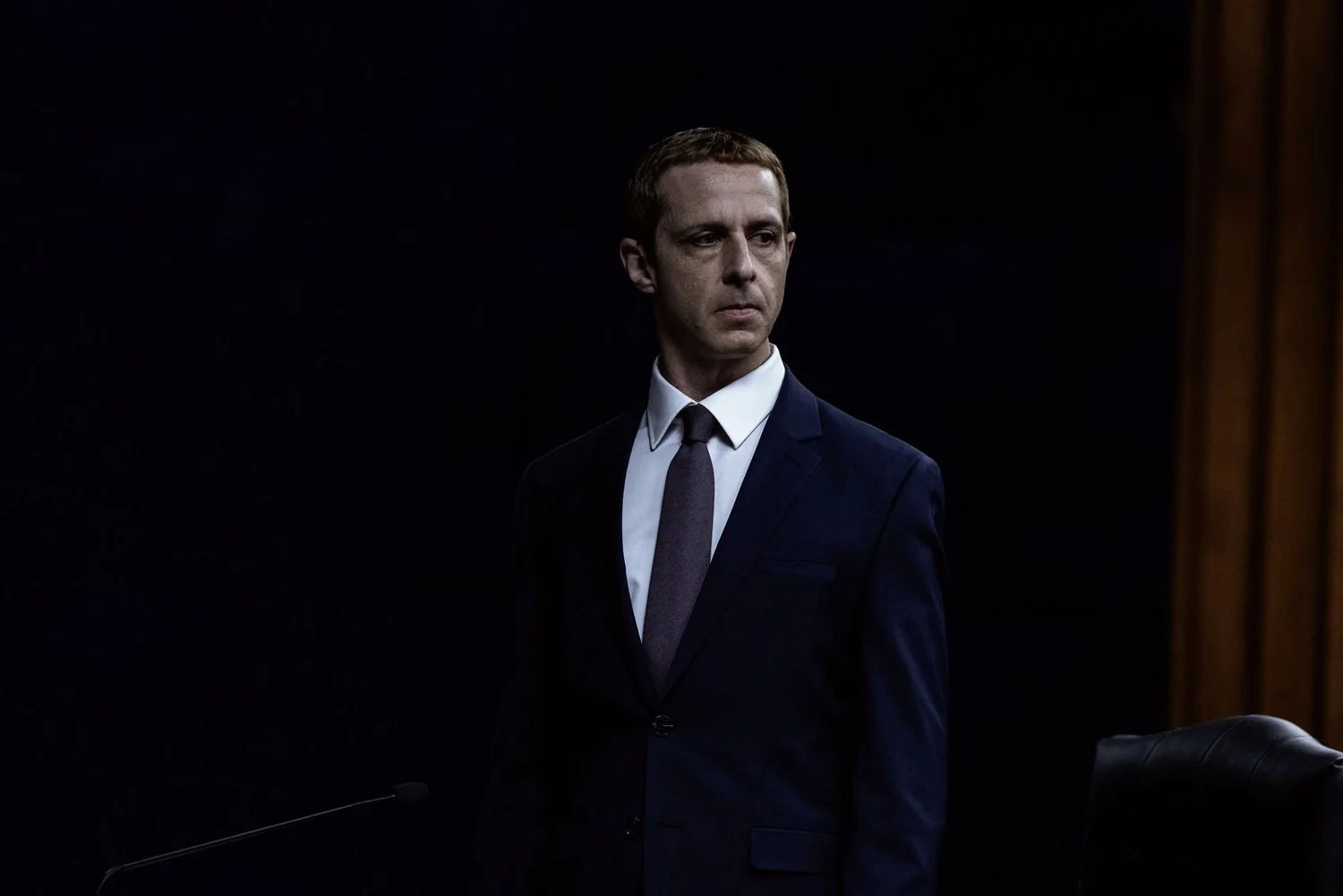
Looming large over The Social Reckoning is Jeremy Strong succeeding Jesse Eisenberg as Mark Zuckerberg. Other than brief interactions and flashback footage inserts at headquarters, the majority of Sorkin’s film has Zuckerberg rehearsing for upcoming congressional hearings on the date of, as fate would have it, January 6, 2020. These segments, woven through a hopscotching timeline spanning the entirety of the movie, involve louder and louder arguments between Mark, his top legal representatives, Raya and Charlie (the placidity-seeking Wunmi Mosaku of Sinners paired with grenade-dropping standup comedian Bill Burr), and department lieutenants, like Haugen’s superior Teddy (the always punchable face of Game Night and No Time to Die’s Billy Magnussen).
LESSON #3: ACCEPTING CHARACTER ASSASSINATION— Speaking of sharp tools that can carve and skewer soft, fleshy things, Sorkin’s script is not whatsoever kind to the Facebook CEO. The villain is easy to spot, as The Social Reckoning is an unflinching character assassination. Anytime Jeremy Strong is on screen, the uncaring and unsympathetic ice in his veins frosts the entire picture. Where the Horwitz and Haugen half aims for positive outcomes, little redeeming good intentionally comes from any of the Zuckerberg scenes, especially when the recreated January 6th insurrection explodes during the third act, forcing the exec to consider growing a momentary spine to use his power dutifully. If you thought Eisenberg’s young asshole of staggeringly petty jealousy was harsh in 2010, apply years of profit, power, notoriety, political favor, and assumed maturity only to enhance maniacal hubris and zero accountability for blame in a genius willing to die on the hill of being a “free speech absolutist.”
Rather than being the murky American Dream borderline biopic that The Social Network was, The Social Reckoning takes its staunch place as a journalism film in the same vein as the greats that came before it, trading Deep Throat talking in parking garages for hotel room meetings and swapping Pentagon Papers for flash drive data drops that would become “The Facebook Files.” While Sorkin’s film has nowhere near the stylish edge and propulsive sizzle of David Fincher’s gem, it chooses, using its own unheeded warning line of “don’t be friction,” to do its damage grinding cinematic sandpaper instead of mic-dropping hammers. The drama lives and dies on the disheartened will of Frances Haugen as a whistleblower, Jeff Horwitz’s stalwart adherence to accurate reporting, Mark Zuckerberg absorbing all the daggers as soulless menace, and the ensemble committing to that methodical and less showy approach. While it takes time and no one is standing out as a future firebrand legend or trophy winner, The Social Reckoning’s scuffed and abrasive path is effective at kicking up smoke and firing up an audience, especially if its recent history remains fresh and unresolved in people’s minds.
LOGO DESIGNED BY MEENTS ILLUSTRATED (#1436)