

Images courtesy o LucasFilm and Walt Disney Pictures
STAR WARS: THE MANDALORIAN AND GROGU— 3 STARS
Building up to the first action sequence in Star Wars: The Mandalorian and Grogu, a former Imperial warlord, played by veteran TV actor Hemky Madera, is standing in front of a meeting table with a collection of his territorial stewards sitting at attention. When he breaks the bad news that he’s raising his tribute price, the evil despot shoots and kills the one attendee who had the gall to question his services. His retort to killing the individual is to demand that those assembled look for “solutions, not excuses.” In many ways, that same demand could match the purpose and existence of this very movie.
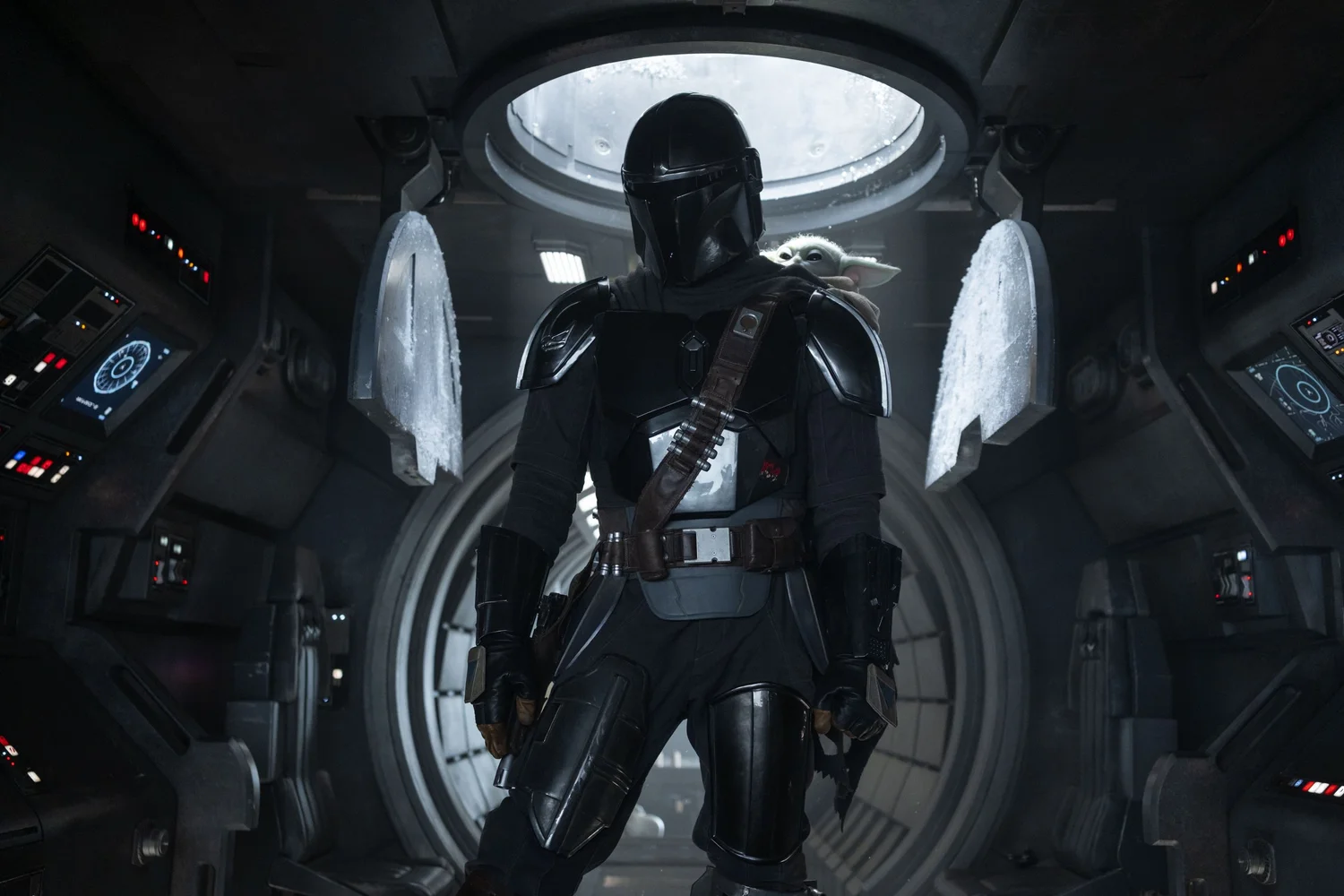
Not long after that diatribe is dropped, the Mandalorian himself (Pedro Pascal, assisted on set by the second and third-billed Brendan Wayne and Lateef Crowder filling the helmet) arrives to apprehend the warlord and collect the lucrative bounty. By the end of the wild opening ruckus, the bad guys are dead, and the Mandalorian returns to his New Republic base empty-handed. When grilled by Sigourney Weaver’s Col. Ward as to why, Mando’s only reply is that things got “messy.” Before the end of The Mandalorian and Grogu, two hours and change later, the same unclean descriptor will be used at least three times again.
LESSON #1: MESSY IS NOT A SOLUTION— On one hand, “messy” is the way the Mandalorian operates with his shot-first/ask-questions-later manner of business. We cheer at his combat prowess and revel in watching his body count of dispatched foes ring up like the scoreboard in Hot Shots! Part Deux. Yet, oddly enough, Madera’s warlord brings up a good point before his demise. In the case of The Mandalorian and Grogu, “messy” too often feels like an excuse instead of a solution as to why we’re on this far-flung adventure.
With three years of planning since the conclusion of the third season of the TV show—where our titular dynamic duo appeared to be finally getting the chance to enjoy the quiet life on their Nevarro homestead—one would expect a better-than-good reason or worthwhile story to get the Beskar-armored warrior and his Force-using munchkin off the comfy porch and back into the universe’s politics. The best the script from director Jon Favreau, fan favorite showrunner Dave Filoni, and The Book of Boba Fett scribe Noah Kloor can manifest is for The Mandalorian and Grogu is The New Republic employing Din Djarin to bring in collars like the aforementioned warlord from Ward’s Iraqi-ish deck of “most wanted” playing cards. The top target slid across the table to Din is Commander Coyne, whose whereabouts are unknown.
Col. Ward’s best lead is getting insider information from “The Twins,” the two crime bosses and cousins of the deceased Jabba the Hutt. The siblings have assumed their uncle’s place of power and relocated their criminal operations to a new Outer Rim planet. In exchange for rescuing and returning Jabba’s sole surviving son and their nephew, Rotta the Hutt (voiced by The Bear’s Emmy-winning heartthrob Jeremy Allen White), the Twins will give the identity and location of Commander Coyne (Jonny Coyne of The Toxic Avenger). Paid with a restored, original stock Razor Crest ship, the Mandalorian begrudgingly takes the job, and off The Mandalorian and Grogu goes.
Maybe there’s a little sizzle to the Hutt name and legacy attached to The Mandalorian and Grogu, but, honestly, not much of this premise and setup feels any better than, say, three episodes of the previous television show itself. As it stands, there’s no threatening cause or higher evil in play or looming above this fray. While this promotion from the small screen to the big one fashions itself as the beginning of a new chapter for these beloved characters, not much storytelling or mythical consequence comes of this big debut. It’s surprising because Jon Favreau and Dave Filoni are better than that.
The most obvious and curious place many fans have been patient for The Mandalorian and Grogu with bated breath of internet speculation is seeing whatever could be the next step of Grogu’s emergence as a powerful user of the Force. He chose Din Djarin over Luke Skywalker to be here, for goodness sake. Sure, he gets to lift a few heavy things and make a few timely saves, but Grogu feels short-changed or, as the gamers say nowadays, nerfed. Halfway through, one henchman calls Grogu “shoulder candy,” and that is damningly his limit in this movie. The enigmatic little guy should be the special attraction, generating infinite aura, and not simply the cute comic relief, even if his coos, grimaces, and snorted laughs will always get automatic “aww” pops and giggles every time.
LESSON #2: SHRINKING FROM LONG FORM STORYTELLING TO SHORT FORM STORYTELLING— The culprit for this somewhat lacking result feels like the reduction from long-form storytelling granted to television to the short-form limits necessary for a single two-hour movie. In each of its eight-episode arcs, especially the iconic first season, The Mandalorian built a Western-esque mystique of methodical and edgy deliberateness and escalating stakes. Playing to the four-quadrant summer blockbuster crowd, that edge is softened to a degree for a dominant hero that sprints instead of stalks. Like many Pixar movies under the same Disney roof, The Mandalorian and Grogu is in a hurry to go everywhere and get everything in. Good luck keeping up with names and cameos, and assigning where they matter.
The saving grace of The Mandalorian and Grogu is that what’s flying across IMAX screens and booming the Dolby Atmos speakers spares no expense of its reported $165 million budget to look, sound, and move like a proper monster studio tentpole. Composer Ludwig Göransson, fresh off earning his third Oscar for Sinners, returns with his signature bass recorder to this Star Wars property after departing after the second season to give the movie its biggest lift with an exotic, otherworldly musical score. While the set pieces pile on each other by the end, Industrial Light and Magic presents clean and kinetic speeder chases, spacecraft battles, and unique creature fights. Even if our badass Mandalorian isn’t as imposing as he could be, the stunt team, coordinated by Mandy Kowalski (Twisters) and J.J. Dashnaw (The Equalizer), put Pedro Pascal and his two stand-ins through an exciting workout when our man has to put boots to asses to street-level adversaries and blaster bolts to expendable droids. The razzle-dazzle is there to satiate, but again, “messy” chaos is a sorry excuse for a missing, grander purpose.
LOGO DESIGNED BY MEENTS ILLUSTRATED (#1394)