
Images courtesy of Black Bear
TUNER— 4 STARS
Quite likely, the leading reason folks choose to see movies in a theater, instead of on the streaming-and-scrolling couch, is for the larger-than-life visuals. The big silver screen delivers feasts for the eyes that drop jaws and raise heart rates with the dazzling entertainment. Sometimes forgotten and taken for granted in second place is what the full theatrical experience can do in the sound department. When done right, there’s sensory excitement between noises that rattle seats and silences that destroy our nerves. Tuner, the narrative directorial debut for Oscar-winning Navalny documentary filmmaker Daniel Roher, recognizes this second type of potential power and seizes it for a nifty thriller that deserves just as many big screens as the summer blockbusters it is poised to swim against.
The twentysomething Niki White, played by budding star Leo Woodall, works as an apprentice for Harry Horowitz Piano Repair, covering the five boroughs of New York City in a weathered and trusty van. The name brand of the business is Dustin Hoffman’s charming and stubborn old codger with a personal history of teaching and jazz partnership with the likes of Herbie Hancock (watch for a later cameo). The two travel on a busy schedule to maintain more decorative and ornamental pianos for the rich and privileged than ones that really get played, much to Harry’s chagrin. His young apprentice is a very special case.
LESSON #1: AN INTRODUCTION TO HYPERACUSIS— Niki is a former child piano virtuoso, unofficially adopted by Harry and his wife, Marla (longtime Broadway and TV star Tovah Feldshuh), after losing his family and developing hyperacusis, a rare hearing disorder of extremely fragile sound sensitivity. With his heightened vulnerability, imperceptible sounds to us are piercing and painful for him. Niki mitigates the noisy urban world with ever-present custom earplugs and noise-cancelling over-the-ear headphones. Regrettably, he’s made a personal choice to no longer play piano, meaning if and when he does in Tuner, houses are coming down and tears are falling (but let’s not get ahead of ourselves).
A side effect, for lack of a better term, of his hyperacusis is that his savant-level perfect pitch from his instrumental upbringing is now even sharper. That superior talent makes him perfect for this blue-collar, coverall-wearing job and attuned enough to impress Ruthie (Bottoms star Havana Rose Liu), a music composition student he meets on a job while she’s trying to score a post-graduate mentorship position. Even though they are on different paths as pianists, they soon click, thanks to his helpful nature and an encouraging romantic nudge from Harry.
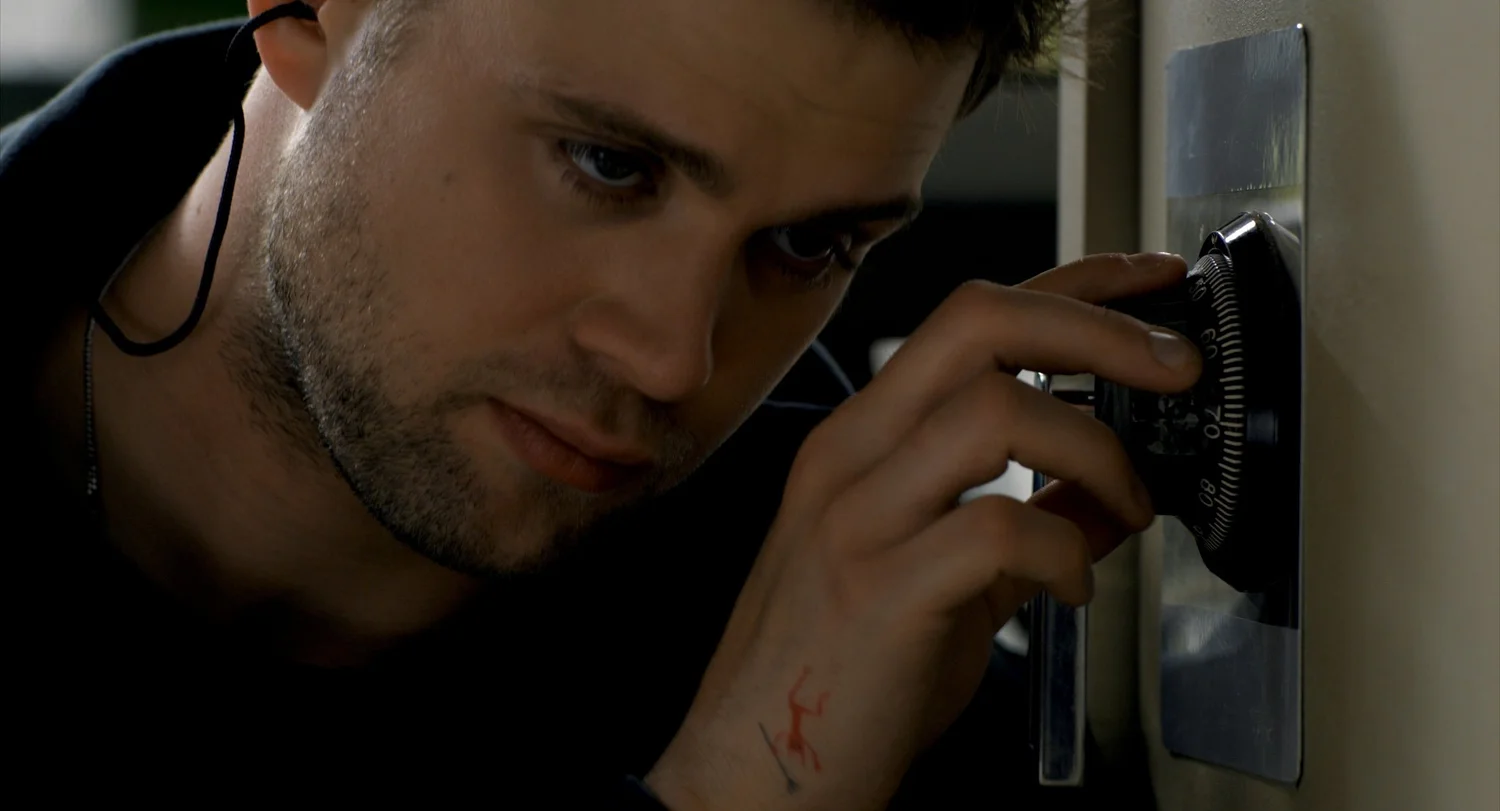
LESSON #2: USING A VERY PARTICULAR SET OF SKILLS— A second and newly discovered upshot of Niki’s hyperacusis is the ability to crack safes. This uncanny aptitude becomes a movie MacGuffin reverberating along the same lines as Bryan Mills’s “very particular set of skills” from Taken, only far less lethal. After flexing his neutral morals to open a safe after running a team of thieves working under the cover of security system installers while staying late on a tuning job, Niki is roped into the criminal underworld by the operation’s boss, Uri (Lior Raz of Gladiator II and Netflix’s Fauda), to make substantial cash.
With this illegal and seedy spin, Tuner takes on the tried-and-true course of a lightly noirish crime drama. Coincidentally, this new endeavor comes at an urgent time when Niki needs money after being repeatedly denied for bank loans to cover medical and business debt accrued by Harry laid up in the hospital. Right on queue, Roher employs a success montage of Niki’s new and secretive double-life of wooing Ruthie by day and pulling down scores with Uri’s crew at night. Naturally, the morals get looser, the scores get riskier, and Uri’s hooks sink deeper, making an exit strategy to get out clean (set to Nina Simone’s “Sinnerman,” a loud and clear heist film nod to 1999’s highly entertaining The Thomas Crown Affair remake) more difficult.
Inside this stressful tug-of-war, Leo Woodhall gives a very engaging performance that straddles between conveying the morose loneliness of his singular world and victorious moments when Niki finds newfound belonging that lifts him from feeling useless and discarded. Tuner completes a 2025 where Woodhall kicked down Hollywood’s door with attention-getting parts in Nuremberg, Bridget Jones: Mad About the Boy, and TV’s Prime Target. The soon-to-be 30-year-old is a surefire star in the making. Matching his appeal, Havana Rose Liu plays a bit of the requisite crime film love interest, stuck occasionally waiting by the proverbial door or phone for her man, but applies a greatly appreciated level of confidence and independence when necessary, which lifts her from the usual formula and shows her rising charisma. While this may all read like the tropes you have seen before in other caper-esque films—where a nice guy is trying to get ahead and avoid an inevitable fall that costs him his livelihood and his love—what makes Tuner stand out is the aforementioned auditory experience.
LESSON #3: DON’T FORGET WHAT A THEATER CAN DO FOR SOUND— Tuner commonly takes on Niki’s sensory perspective, where you hear every breath and possible ding-and-ping in a ruminative racket carefully crafted by supervising sound editor and sound designer Johnnie Burn, a Best Sound Academy Award winner for the haunting dirges of The Zone of Interest. That often maddening immersion is balanced by the smooth trance that comes when piano music—comprised of Will Bates’s stylish score, on-screen music composed by Elvis and CODA executive producer Marius De Vries, and the unifying spine of the old jazz standard “Tenderly”—transports you mentally to another place. These two palettes, merged and expelled immaculately through Dolby Atmos speakers, penetrate your locked involvement in everything that is transpiring.
The audio textures in Tuner are accompanied by intimate camerawork from cinematographer Lowell A. Meyer (Knock at the Cabin) and kinetic editing choices by Greg O’Bryant (TV’s Mr. and Mrs. Smith). Meyer’s framing rests predominantly in close-up and loves to follow the hands and objects making the many sounds, leaving it to O’Bryant to flicker our attention towards new noises and sources, much like what perks the ears and turns the head of the lead character. The blend of it all, hitting our retinas to cochleas, of what is intentionally frenetic turns out so damn smooth. That’s proof of Daniel Roher’s complete control to assemble the polish, suspense, and wit for proper escapism of an easier scale.
LOGO DESIGNED BY MEENTS ILLUSTRATED (#1393)