

Images courtesy of Searchlight Pictures
BEHEMOTH!— 3 STARS
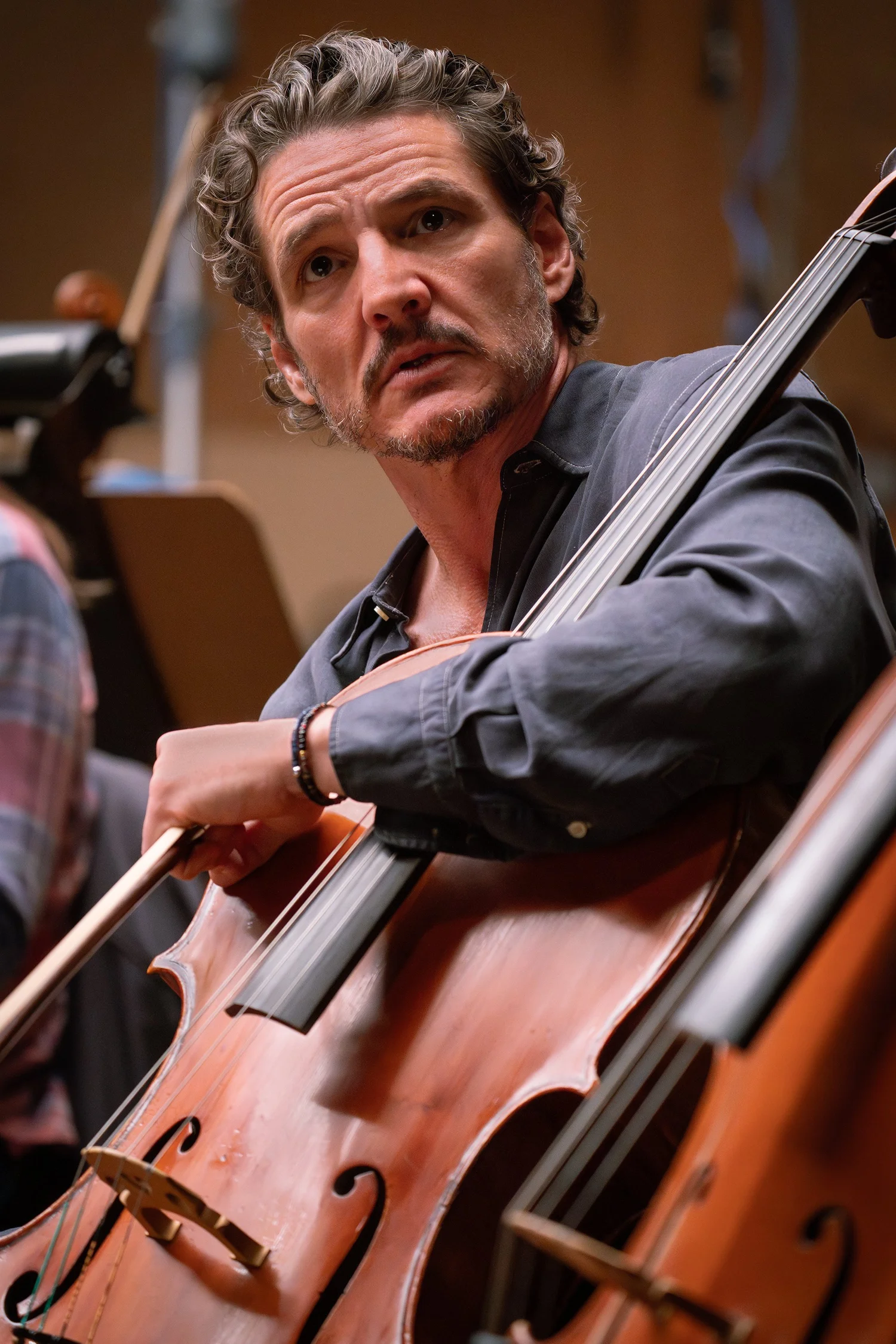
LESSON #1: WATCH HIS EYES— Everything to absorb in the music-triggered drama Behemoth! can be tracked by following lead actor Pedro Pascal’s eyes. No matter the time period of this flashback-tilted story or the central character’s apparent age, the eyes carry the high points and the low points, while nearby ears absorb the music as either the catalyst or the balm of the moment. Behemoth!, directed by Tony Gilroy in his first feature film directorial effort in 14 years, melds those two sensory experiences to explore one man’s existential despair.
In the weightiest lead role of his late-blooming career, Pascal plays virtuoso cellist Alex Serien. Born into a family of musical geniuses that included his composer father Peter (seen entirely in flashbacks and played by Hank Azaria), harpist mother Ginnie (the too-long-overlooked JoBeth Williams), and eventual burned-out rocker and podcasting older brother, Andy (Will Arnett, sticking to the serious actor route he started last year in Is This Thing On?), Alex grew up as a celebrated child prodigy before becoming a renowned concert performer and highly sought-after session musician. Opening Behemoth!, he is returning to Los Angeles after a 20-year absence and nabbing a high-level chair at the historic Barbra Streisand Scoring Stage on the Sony Pictures lot in Culver City to work on a movie score project matching this film’s very title.
That is where Alex’s instrument and demanded talent have currently brought him. Through the start of several recollection scenes, Behemoth! reveals that he has spent the bulk of his professional career shifting between different orchestra assignments nationally and internationally, with prominent stops in Dallas, Boston, and Chicago. Much like the cheeky old sailor saying that became the title of a 1952 Groucho Marx movie, Alex appears to have “a girl in every port” through his seasons in the pit and on-stage. Three of them, in particular—violinist Nadia Hynes (Sorry, Baby discovery Eva Victor), socialite Carol Spedding (The Invite’s Olivia Wilde, constantly and stunningly draped in silk and continuing her incredible 2026 role), and a mostly unseen 15-year-old wunderkind underground recording artist named Viviana Glenn (Alexa Swinton of Maestro)—have made the biggest impressions.
While there’s work in Los Angeles, the real reason for Alex’s return to Hollywood is a stratified series of traumas. First off, this was the home city of Nadia, who emerges in the flashbacks as the one person he was closest in his life to truly loving. Next, his mother, Ginnie, is nearing the end of a long battle with dementia, which brings the two brothers back together to manage her final affairs and relitigate their demanding and damaging upbringings. Lastly, even after a terrible car accident in Chicago destroyed his prized Granchino cello and nearly injured him in the process, Carol is the unhinged ex-girlfriend who will not take “no” for an answer and stalks him across the country, trying to win him back.
More often than not, chords and strikes of music prompt the unlabeled memories of Alex, where the songs bleed into scenes of different locations. In these transitions, our only evidence of a time change is the wavering amount of grayed salt appearing in Pedro’s facial hair. Thanks to the symphonic spirit of the nine working composers— Michael Giacchino, James Newton Howard, Michael Abels, Emily Bear, Henry Jackman, Lukas Frank, Brandon Robert, Nami Melumad, and Alan Silvestri—who are calling themselves “The Behemoth! Collective,” the mood of the film bends liberally with the variety of orchestral music being worked on. Their measures and cues sway from seduction and suspense to reflection and remorse, all while Pascal convincingly conquers the cello on-screen after a boot camp of training. Huge kudos go out to the coaching team of Timothy Loo, Charlie Tyler, and Peter Winkler for Pedro’s preparedness.
Tony Gilroy’s swerve from a typical “you can always go home” framework for Behemoth! avoids the extreme forms of chipper nostalgia or forced outrage that tend to create the showy monologue moments of this storytelling trope. Alex Serien isn’t coming back to take anything over or deliver some comeuppance of overdue closure. He’s eerily reserved and often silent. This is a man just trying to navigate what happens and come out the other side stable.
Throughout this path between gigs, call times, and appointments, it’s the arsenal of furrowed expressions by Pedro Pascal that flesh out the eccentricities on display in Behemoth!. Memories most certainly hit him, but never derail a grander focus, which feels like the by-product of rigorous training and compartmentalization. With him, there’s never a meaningless blank stare. Rather, narrower than the far edges of bliss and anger, his emotional pendulum swings between the boundaries of malaise and profundity.
LESSON #2: GAZES OF MALAISE— Alex’s unhealed torments lead to gazes of uneasiness. Whenever Carol is around, anything beautiful stops, his nerves increase, and his appalled defenses go up, like he’s blocking new memories out as they are happening. Conversely, due to his inability to bond with people with much permanence or affection, he has reached a point where some memories come from the disappointment of missing the good things that were in front of him. Lost loves are the frequent culprit.
LESSON #3: GAZES OF PROFUNDITY— Before that malaise sets in, the mental meditations punch with profundity. Alex’s aloofness subsides, and his stillness takes over. Once again, lost loves are the frequent culprit. In a very poignant supporting role, Eva Victor is luminous as the proverbial “one who got away,” capable of provoking reactions of thoughtfulness and restlessness. Coming from another source of awe, Alexa Swinton’s mystery girl floats like a spectre over the movie as to who and what she is. Orbiting around both wavelengths of Lessons #2 and #3 is Alex’s repressed fear of playing or sharing any of these feelings out.
If this combination of profundity and malaise sounds as prickly as it does fascinating, you are sensing some of the overall difficulty of Behemoth! The film is masterfully made, with the aforementioned rich music and a surgical effort of editing to splice the present and the past, and Pedro Pascal commandingly occupies every minute of the movie. Yet, like a long musical piece missing a crescendo to really telegraph its time, something sizable feels missing. Maybe it’s the unreturned words to go with those telling eyes during the introspective interludes. At many points, past and present, people confront Alex Serien with the simple question of “What are you doing here?” Each time, and with the music’s energy, the answers and tones differ, and the reasons vary to make honesty and clarity seem inconclusive. As often brilliant as Gilroy’s film is, it doesn’t fully answer that question of itself either, where aimlessness robs importance.
LOGO DESIGNED BY MEENTS ILLUSTRATED (#1449)