
Images by Aidan Monaghan and courtesy of A24
THE DEATH OF ROBIN HOOD— 3 STARS
The Death of Robin Hood opens with an evening of the harsh natural elements of its Northern Ireland shooting locations, captured in the textured fleck of Pig cinematographer Pat Scola’s 35mm film stock among heavily veiled effects assistance from ILM. In the year 1247, A young woman is scrounging for food and safety through a rugged, verdant landscape and the harsh cold of billowing mist and pelting snow. She spots a single fire in the distance and walks to join the maker and keeper of it. Much to her relieved surprise, she discovers the title character, a man of legend played by headlining Academy Award nominee Hugh Jackman. But, in short order, this is where the L-word vanishes in Michael Sarnoski’s film.
LESSON #1: THE LIES OF LEGENDS– The curious young woman asks him a litany of questions about the legend of Robin Hood protecting the meek, enjoying the great love of Lady Marian, and being a fighting champion for Christianity. To each query, the grizzled man before her labels the lie and dispels the myth. No one protects the meek. There is no great love. He never prayed. He says people saw meaning where there was none. Rather than feel remorse, he is tired. Not long after this scene, the woman is dead and is granted a crude, shallow grave with no mourning from our would-be hero.
In The Death of Robin Hood poster did not already warn you, that right there is the brusque and dissentient attitude of this character and the entire film. Anything “merry” is as far away as the Sun during this drastic display of weather. Like body parts, the somberness can be cut with a knife or the deep strings and choral hymns from composer and folk singer Jim Ghedi, working on his first film. After all, this is an A24 film, which, for some, means they might be “A” for asleep within 24 minutes. For others, it’s 24 facets of “A” for art. Either way, this pensive film is far from a thriller, and that takes a mood and mindset to remain present with and eventually appreciate.
Along his hiked trek, Robin meets with his longtime and last-remaining friend, Little John (Nosferatu’s Bill Skarsgård). The bearded man needs help with a family beef to recover his pregnant spouse, Margaret (newcomer Katie Breen), and young daughter, Little Margaret (Faith Delaney of Hamnet), from an imposing local lord (veteran TV and film tough guy Clive Russell). In a violent battle lit by a crude farmhouse on fire, Robin is severely injured in one-on-one combat, though saved and spared from a killing blow, one he was ready—and even eager—for. Seeking healing, Little John whisks his friend away by boat to the offshore Kirklees Priory.
On this serene island, Robin—going by the name Randolph to hide his reputation—is slowly nursed back to health by the prioress, Sister Brigid (Jodie Comer of The Bikeriders and The Last Duel), and her “magical” methods of bloodletting. In his early days there, Brigid remarks that Randolph screamed and begged her to let him die. As time passes and Robin gets back on his feet, he is encouraged in penance to make himself useful on the property by way of trapping game and assisting a dying, soothsaying leper (The White Lotus Emmy winner Murray Bartlett) tend to the garden and fruit trees.
LESSON #2: FINDING A REASON TO LIVE— One day, little Margaret arrives on the same raft to the island without her father, meaning the priory is now the only place safe for her. Soon after, she is followed by another wounded young man (A Quiet Place series co-star Noah Jupe). The presence of this surviving child and an impressionable young man stokes the smoldering cinders of honor buried in Robin, giving him a reason to live a little longer. On a philosophical front, Robin finds kindred spirit conversations with the leper—a fellow man who knows pain and sorrow—and is encouraged by Brigid, who knows Randolph is hiding his true nature, to take heed of scriptural beliefs such as Deuteronomy 31:8 where death is not the end and a place is ready for him. Much of this lesson can also be funneled to the notion of fates and lives crossed. For a battler like Robin, those encounters became chances for him and others to live or die through the wide canyon between murder and grace.
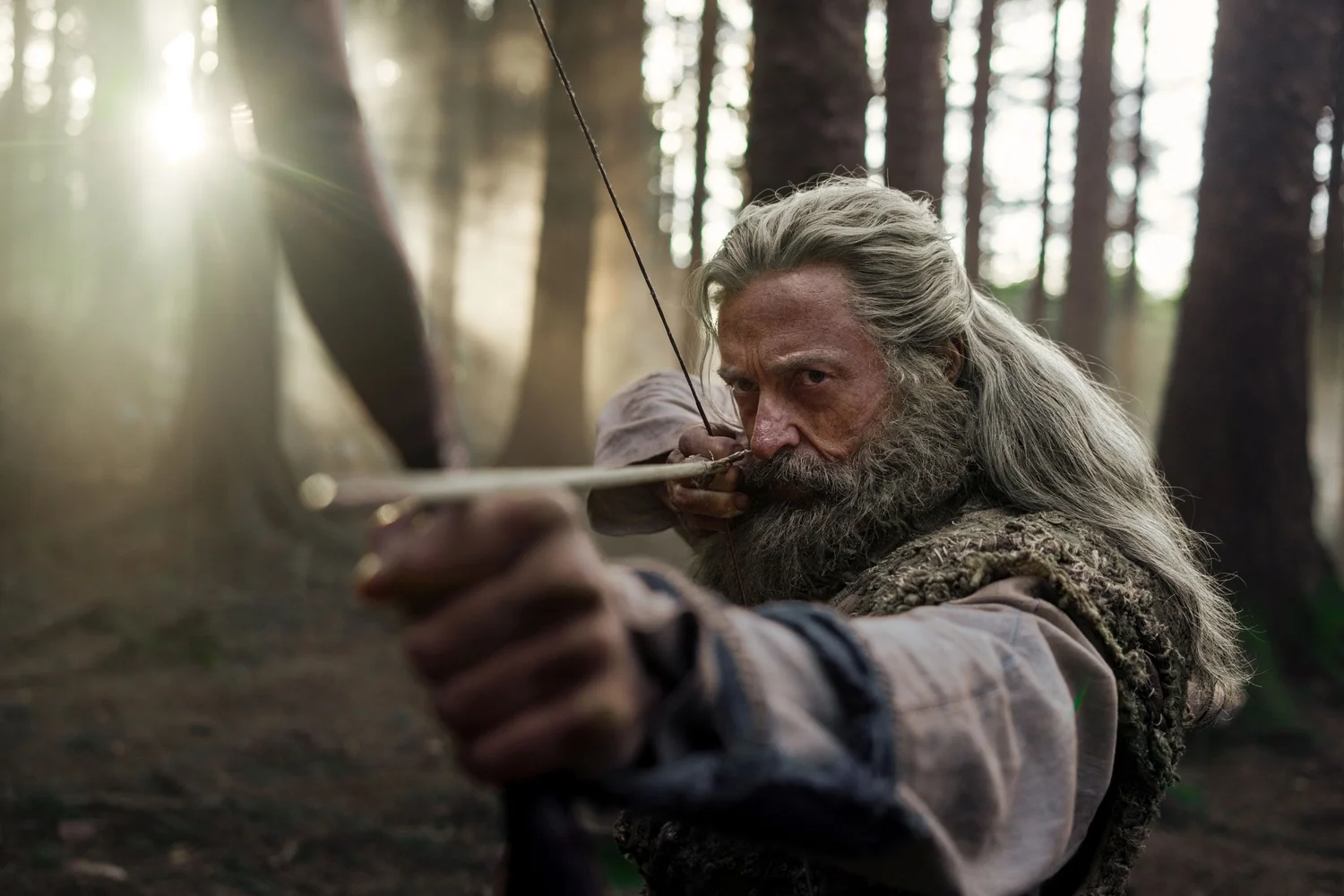
This reflective drama is placed on the shoulders of Hugh Jackman, who, pivoting to the opposite extreme of his esteemed talent last seen in the holiday crowd-pleaser Song Sung Blue, descends to a stiller place with The Death of Robin Hood. With that cocked left eyebrow and the sinewed creases of age on his face, there is still virility beneath the long, silvered tresses of his excellent hair and makeup. Though his dialogue and chances for action are sparse here compared to the other legends he’s collected on his vitae (Wolverine, Captain Hook, Van Helsing, and P.T. Barnum), Jackman melts, well, considering the climate and palette, rather freezes into this part quite capably.
LESSON #3: STORIES CREATE POWER— Later in the film, a bit of Lesson #1 is echoed when Robin discusses religion with Sister Brigid. He posits that stories create power, power leads to terrible things, and those terrible things become new stories to continue the cycle. Emphasizing his own underlying murderous past, he sees his life matching that parallel course. That discussion stands as a summation of The Death of Robin Hood and Saronski’s intention to downplay any and all grandeur. Instead, the movie conveys the grimness, minus the kingly connections, of the eighth and final fytte of A Gest of Robyn Hode in its portrayal of this fabled character’s demise. An arrow shot out of a window to mark a man’s elegiac burial would be too simple.
Those envisioning or, worse, requiring the likes of Errol Flynn, Kevin Costner, Sean Connery, or Cary Elwes are walking into the wrong movie in the wrong season of the year. For better or worse, The Death of Robin Hood is heft over heroics, remorse over reverie, sin over spectacle, anguish over adventure, and, as previously warned, monster over myth. As rich on some levels as those thickly hewn themes may be, this can be a very 0plodding path taken to meet and embrace them.
LOGO DESIGNED BY MEENTS ILLUSTRATED (#1401)