
Images courtesy of Searchlight Pictures
IN THE BLINK OF AN EYE— 2 STARS
This critic firmly believes there’s a place for contemplative science fiction in cinema. Not everything in that genre has to be a space opera or special effects extravaganza. When done right, heady ideas and anchors of the human condition can move a viewer as much, if not more, than spectacle. Filmmaker and animator Andrew Stanton’s latest foray into live-action, In the Blink of an Eye, available on Hulu, desperately wants to be the highest kind of exemplar for favoring the evocative over the explosive.
What does that desperation look like? Well, the introductory scenes of Stanton’s film quickly expand the theoretical Big Bang out into the primordial soup of a tide pool propagating organic life. In doing so, In the Blink of an Eye drops this excerpt of a Sylvia Plath quote:
“Remember, remember, this is now, and now, and now.”
LESSON #1: USE FULLER THOUGHTS TO GET A FULLER EFFECT— Citing a great poet like Sylvia Plath is a worthy genuflection, but it’s also the first place where In the Blink of an Eye, penned by screenwriter Colby Day, stumbles. If you’re going to go there, use the full quote to get the full effect. Take a look at the full quote:
“Remember, remember, this is now, and now, and now. Live it, feel it, cling to it. I want to become acutely aware of all I’ve taken for granted.”
The imperative emotions and statement of desire in the second and third sentences of Sylvia Plath’s words rattle with the stirring sensations of the human condition that would match a contemplative setting. Those are the lofty goals in which to parallel. Instead, In the Blink of an Eye bangs its opening gavel on the first line of the quote, which, by itself, might as well sound like the tough-tied Bud Abbott and Lou Costello trying to figure out who’s on first base.
Immediately, we’re already lost, and that type of incompleteness and incongruity mars the film. Determinedly, In the Blink of an Eye stretches its storytelling yarn across a triptych of stories that span nearly 50,000 years of human history. The oldest stitch in the tapestry is set in the Neolithic era of approximately 45000 BC. The film presents the life of a burgeoning family of Neanderthal humans consisting of a parental unit named Thorn and Hera (prolific TV actor Jorge Vargas and Yellowstone’s Tanaka Beatty), their teen daughter Lark (Skywalker Hughes from Ordinary Angels), and new infant boy living in the oceanside serenity of the Pacific Northwest (shot in stunning stretches of British Columbia).
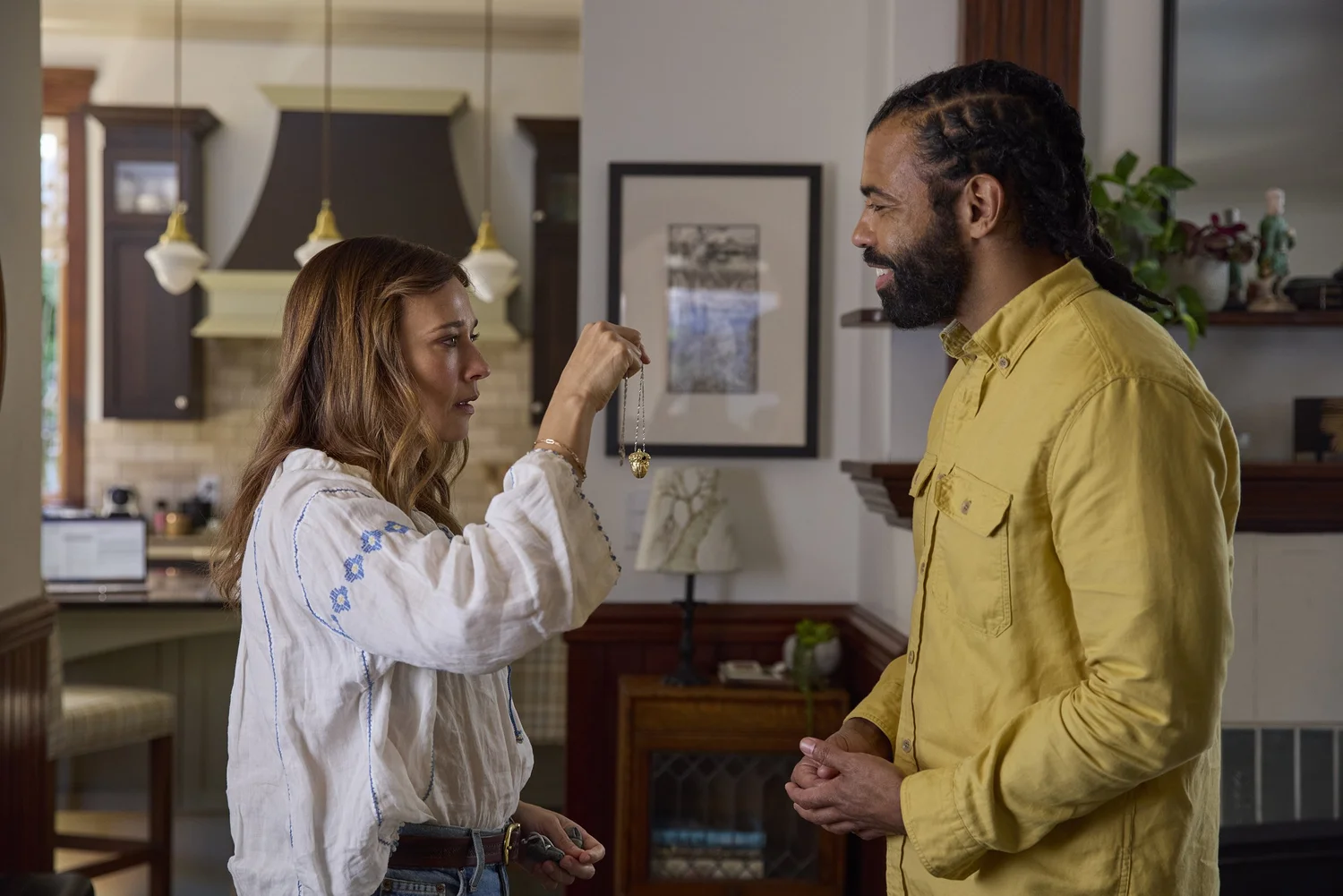
With an odd editing splice triggered by successful coital sounds between Thorn and Heda to those of unromantic failure, their arc is paired with that of a present day scientist named Claire Robertson (Parks and Recreation favorite Rashida Jones) who is trying to navigate an exit from a tipsy one-night stand with her co-worker Greg (Hamilton star Daveed Diggs). When she’s not neurotically avoiding a serious love life, Claire is an anthropologist researching genetic diversity and the misnomer “Missing Link” traits of Neanderthal people for her doctorate.
Sticking with the borderline inappropriate sexual vein to use the mechanical pulse of a personal vibrator melding into the buzz of an alarm clock on a spaceship for another switch of settings, In the Blink of an Eye completes its trio of introductions with Coakley (the headlining Kate McKinnon, playing it straight). She is a “longevity-enhanced” astronaut in the year 2417 representing a corporation named Elixir. Coakley is piloting a vessel carrying the future of the human race in the form of preserved embryos to a hospitable moon near the gas giant Kepler-16b, approximately 245 light years from Earth in a binary solar system containing two suns (which means someone creative is clearly living out their Tatooine sunset dreams from Star Wars). She is 210 years into this trip with 126 to go, and her only compassion is the intuitive AI program ROSCO (voiced by Rhona Rees).
As In the Blink of an Eye blends these three storylines with hopscotched attention, conflicts are naturally introduced. Primitive day-to-day survival and the presence of other neighboring humans challenges Thorn’s resilience to care for his family. With Greg’s growing and affectionate help, Claire precariously tries to hold onto her academic progress while supervising the failing health of her mother (Karin Konoval, shedding the digital performance capture pixels of the recent Planet of the Apes prequel trilogy). Meanwhile, Coakley’s oxygen-creating plant archive is showing signs of sickness, requiring drastic measures to be taken for the completion of the greater mission.
When done right, conflict should indeed reveal and emphasize the mindful themes that make contemplative science fiction, which, again, is the supposed aim of In the Blink of Eye. With apologies to advanced botany, terminal cancer, and caveman medicine, none of the pitfall struggles of the film resonate strongly. That’s more than a shame from the animator who couldn’t have done it better than with his Oscar-winning classic WALL-E. Coincidentally, out of the film’s three arcs, Vargas’s ancient one with, funny enough, the least amount of dialogue comes the closest to feeling compelling. When we leave him for the talkers, the wind leaves its sails.
LESSON #2: KNOTS OF HAPPENSTANCE CANNOT HOLD DRAMA TOGETHER— In presenting these three storylines in In the Blink of an Eye, twinkles of happenstance pretend to tie everything together. Carrying no epiphany or spoiler-level surprise whatsoever, it is highly suggested that the new humanoid fossil sample Claire is studying is Thorn or one of his descendants and, maybe—just maybe—her life’s work could inspire the generation that starts Elixir that makes Coakley’s mission essential. Unfortunately those ties are very loose, as the accelerating third act of the film piles one little happy ending win after another, arriving from places without jeopardy or challenging mental debate to move the heart or mind. A big cornerstone feels missing.
LESSON #3: CONTEMPLATIVE SCIENCE FICTION NEEDS AN ANCHOR— Memorable contemplative science fiction needs at least one hefty anchor, something that binds or channels the greater meaning of it all. For In the Blink of an Eye, you need an anchor that can span this large expanse of time and provide either purpose or motivation for the characters’ pursuits to endure and see their lives through. The best we get out of Day’s script, itself a hot buy from the famed 2016 “Black List”—is an acorn. That’s right—the same smooth ovular nut of an oak tree pursued by Scrat across innumerable Ice Age movies. Sorry, though “acorn” may be spelled with the same letters in the word “anchor,” it is not one of those. Even at a tidy 95 minutes, if a film like In the Blink of an Eye is going to make us wait that long for the big symbol, the connection needs to be better than that. The theme of parental pride across three eras was sitting right there, and they missed it for earthy granola symbolism set to a slight Thomas Newman musical theme we feel we’ve heard before in a half-dozen other films.
LOGO DESIGNED BY MEENTS ILLUSTRATED (#1375)