

Photo Credits: Stefania Rosini and Row K Entertainment
Official Selection of the 61st Chicago International Film Festival
DEAD MAN’S WIRE— 4 STARS
Movies, being the empathy engines they are, have relished the chances to showcase criminals who were in the right. From dramatizing or even romanticizing whistleblowers and activists to revolutionaries and rebels, these types of “based on actual events” stories have been featured in outstanding films that have stirred up their fair share of civil disobedience and positive social change. While Dead Man’s Wire rips from a nearly half-century-old headline instead of a modern one, this engrossing comeback film for director Gus Van Sant waylays its own inspiring level of personal and public vindication that echoes today.
On Tuesday, February 8, 1977, in the Circle City of Indianapolis, Indiana, 45-year-old Tony Kiritsis entered the office building of the Meridian Mortgage company when it opened for the morning. Wearing one arm in a sling and carrying an awkward long box in the other, he expected to have his request for an appointment filled by the figurehead of the firm, M.L. Hall. Due to a scheduling error, the top man is out of town, vacationing in Florida, leaving his son, Richard, as the next ranking director present. Miffed and flustered, Tony accepts this lesser meeting and enacts the big plan he had anyway for this chosen encounter.
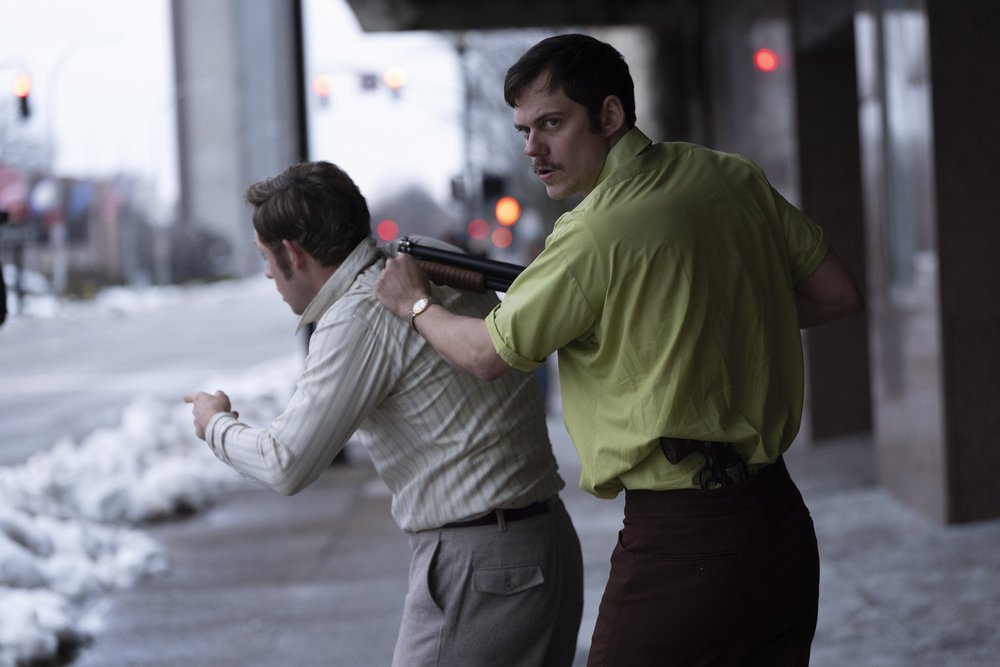
LESSON #1: THE MEANING OF THE FILM TITLE— When Tony gets Richard alone, the sling drops away to reveal a revolver, and the box thought to be containing rolled blueprints has a sawed-off shotgun with unique modifications. This is where the title, Dead Man’s Wire, lives up to its name. Two thick wires extend from the firearm, which has had its safety mechanism removed. One extends from the end of the barrel and is tied like a noose around the neck of the selected target—in this case, Dick Hall—and the other is attached to Tony’s person. Both lead back to the shotgun’s trigger. The physics and logic at play are: If the assailant or the captive is incapacitated, the separating yank will make the gun fire—right into the back of poor Mr. Hall’s head.
And with that, we have ourselves a hostage situation called in to the police by Tony himself. Played by professional movie creeper Bill Skarsgård of the It franchise and last year’s unnerving Nosferatu adaptation, Tony Kiritsis has a beef with M.L. Hall (Al Pacino, a nice get for Van Sant) over a 17-acre parcel in Tennessee that has increased greatly in value. Struggling to make ends meet, Kiritsis is late on his mortgage payments and is highly suspicious that the Hall family wants to acquire the land when he defaults to sell it at a high profit that lines their pockets instead of his own. A year removed in time from the great film Network, one can say, on this fateful morning, Tony Kiritsis is as mad as hell and not going to take it anymore.
In a daring daytime move, Tony escorts Richard (former Power Rangers star Dacre Montgomery) by his dangerous contraption out of the office building with the intention of bringing Richard to his apartment. He is greeted by the sirens and gunpoints of Indy’s finest, led by Detective Mike Gamble (a nearly unrecognizable Cary Elwes, working underneath stellar hair and makeup hiding his signature wavy blonde locks), and the lucky camera lenses of a city news crew led by reporter Linda Page (Myha’la of Bodie Bodies Bodies and Leave the World Behind). Their on-the-spot camera footage of this risky ruckus soon garnered national attention, as the hours and demands of the escalating situation increased in quantity and specificity.
LESSON #2: THE WILDNESS OF LIVE MEDIA— Another off-kilter presence enters the fray when Kiritsis requests chances to explain his side of the story by frequently calling into his favorite local disc jockey—the jazz aficionado Fred Temple, played by the smooth and illustrious Oscar nominee Colman Domingo—during the crisis, turning the radio host into a de facto hostage negotiator. By showing this watchful and precarious perspective of the media getting involved, Dead Man’s Wire harkens back to a time when urgent “special reports” that interrupted immovable national broadcasts carried news as compelling and vital as the viral alerts that blow up our phones today. The potential violence and Tony’s proclivity for swearing loudly created a wildness on live media where people couldn’t look away, especially if lives were on the line.
It is very easy to react to the twitchy and verbose Tony, performed manically by Bill Skarsgård, with the same labels of “extortionist” and “thug” that the actual man received. However, as more details come to light next to the reactionary performances of Pacino and Montgomery, Tony’s stump gets a little taller, and his soapbox finds more and more dirt to clean. By the time Dead Man’s Wire reaches a climactic press conference and bumps John Wayne receiving a People’s Choice Award, the film has shifted your fears and allegiances in different ways. We feel for teh guy, but he’s still holding a loaded and live gun to someone’s head. Those curious for the actual history can watch the archived actual one here, and, by golly, it needs to be seen to be believed.
Using Alan Berry and Mark Enoch’s 2018 documentary, Dead Man’s Line (available in full on YouTube), as a basis, Gus Van Sant, a two-time Academy Award nominee for Best Director (Good Will Hunting, Milk), comports himself extremely well in his first film in seven years. Austin Kolodney’s well-referenced script keeps much of the historical detail of the Kiritsis ordeal in place and presents it in a swift and savvy feature film that is one part docudrama pot-boiler and one part rogue’s caper film. Composer Danny Elfman’s score combines the zings of a harp woven into suspenseful percussion beats to create both amusement and tension. Van Sant extends that sense of atmosphere with a blended selection of diegetic period music playing through car radios and home stereos and top-notch production design, set decoration, and costume work enlivening the wintery season of 1977.
LESSON #3: DEPICTING JUSTIFICATION— The most laudable trait of Dead Man’s Wire, outside of its style, is its observant presentation of the Tony Kiritsis story. Softening the unhinged red-ass of a character to lionize him next to the likes of Robin Hood would manufacture cheers, but come across as less than authentic. When Skarsgård shouts in character, just as Kiritsis famously did, that he was “a goddamned national hero,” skepticism remains possible and valid, even amid him winning over public opinion. Because Dead Man’s Wire is candid enough to present the positive and negative facets of the many individuals caught up in this frenzy, the even-handed movie grants you the intelligence to rub your chin, squint your eyes, perk your ears, and question whether judgment or justification can be granted as events transpire all the way to the closing credits.
LOGO DESIGNED BY MEENTS ILLUSTRATED (#1365)