
Images courtesy of Vertical Entertainment
THE MAGIC FARAWAY TREE— 3 STARS
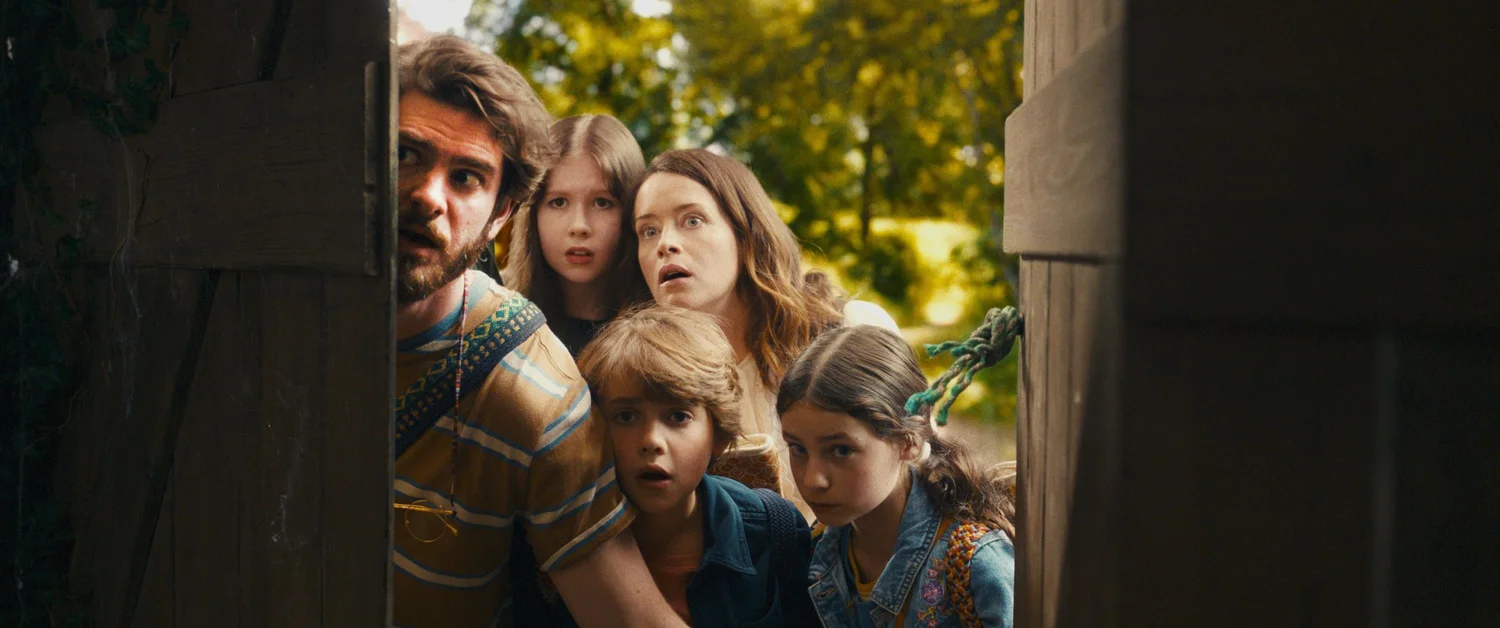
One part of the parental side of the plot of The Magic Faraway Tree centers on two parents, played by two-time Oscar nominee Andrew Garfield and two-time Emmy Award winner Claire Foy, who are desperately trying to win the attention of their three device-addicted kids, all in the teenage or pre-teen age bracket. They are British city kids who have been living in decent middle-class privilege, with Garfield’s Tim Thompson acting as the stay-at-home parent, partnered with Foy’s breadwinning inventor mother, Polly. When Polly resigns from her job after taking a wisely ethical stand, the need arises to transition, downsize, and pare down costs and accoutrements, including those precious screens.
Pulling out his and his wife’s “Dream Journal,” echoing a little bit of the “My Adventure Book” out of Pixar’s Up, Tim champions fulfilling a long-held dream of moving from the urban hustle and bustle to the countryside to start a homegrown tomato sauce business. Tim and Polly purchase a tumbledown barnhouse with no electricity or running water, embarking the Thompsons on a potential new adventure, much to the protest of the two oldest children, Beth and Joe (Delilah Bennett-Cardy in her feature film debut and Phoenix Laroche of TV’s Malice). They are crushed without their entertainment and connections, and, like many such adolescents, don’t see their problem or the longer vision.
LESSON #1: BREAKING DEVICE ADDICTION IN CHILDREN— With this circumstance and new set of goals in mind in The Magic Faraway Tree, it begs the question of what it would actually take to win the attention and approval of the device-centered youths of today. Would it be what’s in the film, as in a set of parents instituting a cold turkey removal of wi-fi, a migration to analog country isolation, and the nudging increase of go-out-and-get-dirty experiences? Sure, that stuff tends to work in fictional movies, but what about stepping out of the movie itself to the theatrical and streaming marketplaces, trying to get butts in seats to turn off screens for a show?
Would a fantasy-heavy film of—and here’s the key—watching someone else have the tactile and engaging experiences be enough to satiate or break device addiction for two hours or, hopefully, even more hours beyond it? Will watching something like The Magic Faraway Tree inspire new imaginative memories, or do kids and their possibly equally device-addicted parents take this 110-minute pause button and go right back to their digital distractions with no lasting effect? That’s the challenge of prolific TV director Ben Gregor’s new film trying to offer amazing change.
Beyond Tim’s commitment to make the best of every dusty, broken situation and the united front of support from Polly, the linchpin of this wholesale family change in The Magic Faraway Tree falls to the youngest of the Thompson clan, Fran, a selective mute played by Billie Gadson of Here and Cruella. In the woods near the new family home, she discovers a fairy named Silky (Bridgerton star Nicola Coughlan, channeling all of her whimsical adorableness), who grants her a map and an invitation to visit the titular tree. The massive timber is a gateway to layers upon layers of thematic realms above the clouds, overseen by the welcoming Moonface (a jovial Nonso Anozie of Game of Thrones and Cinderella) and populated by a cadre of colorful confections and bizarre characters.
LESSON #2: KEEPING IMAGINATION ALIVE— Soon, Fran introduces her siblings to The Magic Faraway Tree, where its extravagances and misadventures start to win them over as well, breaking a large measure of that long-held device dependence. Moonface and his people, who have clearly existed for generations, are delighted that new children are now frequenting their special place. It’s almost as if they are reliant on such visitors and, to a larger extent, believers who don’t grow up and forget about them, à la Bing Bong from Inside Out. Within the kids and the residents, there is an urgency for keeping imagination alive.
LESSON #3: LEARN VS. PLAY— A piece of that struggle confronts the family outside The Magic Faraway Tree. Freda, the uppity rich grandmother of the Thompsons (comedienne Jennifer Saunders), upon visiting the new country abode, asks why the kids are “playing” instead of “learning” with a doubting expression. With Andrew Garfield showing off his fullest Dad Mode appeal with granola grit to be commendable against external pressure, Tim is quick to retort with a proven axiom every preschool teacher in the world will echo: learning can come from play. Not everything needs structure, standards, and defined outcomes, and even older kids can still make great gains from good old-fashioned playtime. The same goes for picking up a book instead of a smartphone. The unique, visionary, and open-ended experiences of The Magic Faraway Tree are golden reminders and reinforcements of that way of thinking.
Similar to John Carter coming from pre-World War I literary roots to finally debut on a movie screen years after its respectful imitators like Avatar, there’s a chance too many kids are going to see a Roald Dahl knockoff amidst the responsive visual effects and enveloping musical score from Florence and the Machine band member Jennifer Saunders, which paint and pulse this dreamy picture. Without doing the homework, they won’t recognize that what’s forged with deep creativity in The Magic Faraway Tree comes from source material that predates Roald Dahl’s Charlie and the Chocolate Factory by 21 years.
That said, the success or failure of The Magic Faraway Tree and its potential sequels will not be from a lack of effort, inside or outside the movie, or any type of weak heart. Calling back to a simpler time to adapt author Enid Blyton’s cherished 1943 children’s novel of the same name, actor and writer Simon Farnaby (Paddington 2 and Wonka) and his screenplays have found plenty of proven cinematic triumph in modernizing fantasy for new generations. He was the right man for this job, and having high-profile and successful actors like Claire Foy and Andrew Garfield embrace this type of independent, non-studio-backed film with dedicated and emphatic performances counts as a second stamp of quality. Supposed simplicity and familiarity aside, there is a worthy gem here.
Images courtesy of Vertical Entertainment
LOGO DESIGNED BY MEENTS ILLUSTRATED (#1424)