
Images courtesy of Warner Bros. Pictures.
THE END OF OAK STREET— 4 STARS
So often in horror or survival situations shown in movies, those with their heads on swivels and who are mindful of their surroundings tend to make it out alive or, at the very least, live longer than the norm. The fancy term for this type of skill is probably “threat assessment.” Let’s make it simpler with this lesson for The End of Oak Street, the big studio leap and first directorial effort in eight years being made by celebrated It Follows indie filmmaker David Robert Mitchell. Not to sound like Fred Rogers calling for community witnesses of catastrophe to always “look for the helpers,” but viewers undoubtedly take moments in a movie like this to spot the “noticers.”
LESSON #1: WHO ARE THE “NOTICERS” IN A THRILLER?— There are savvy characters who see details, ask the right questions, plan accordingly, and, with that self-driven acumen, react quickly when necessary. Then, there are those classic opposites who are in over their head and notice next to nothing. They’re the ones we collectively groan at in the communal theater experience because you know the choice they’re making or about to make is, clear as day, fueled by unawareness. Once again, regular moviegoers, regardless of the genre at hand, can spot who are the “noticers” and who are not in the first 20 minutes of a movie, if not the first five.
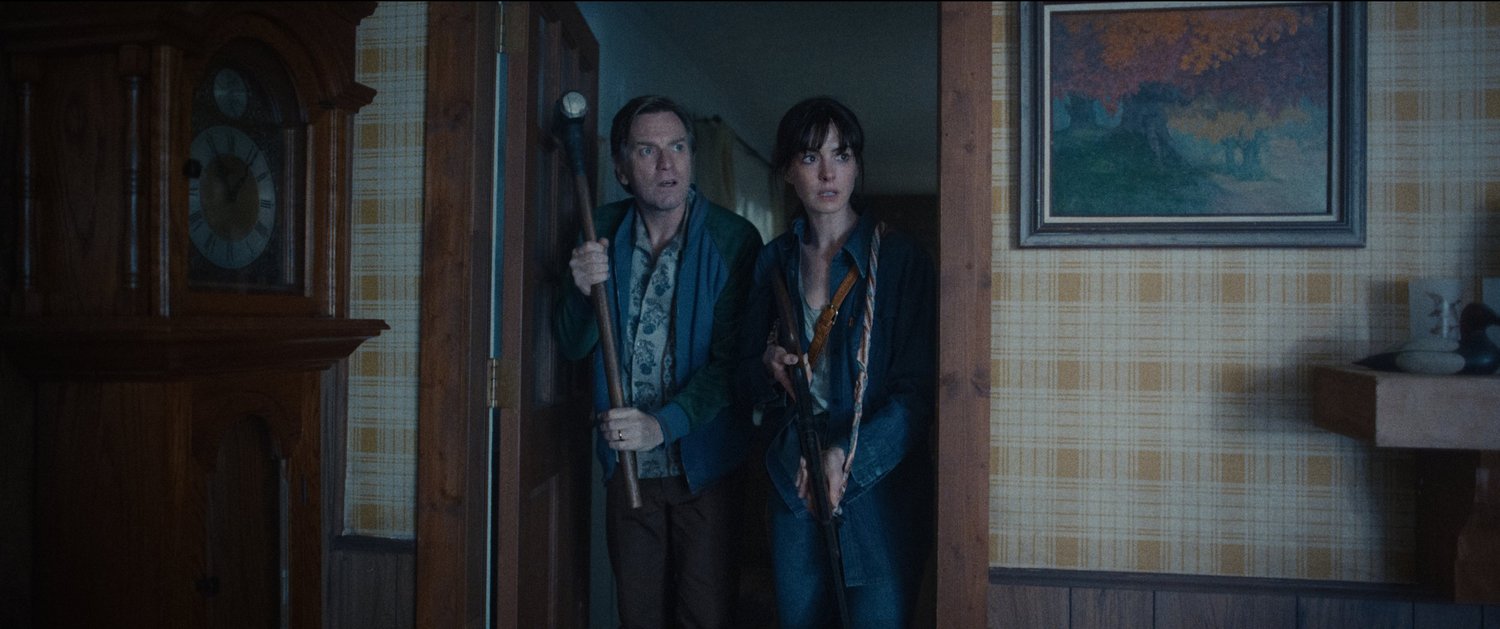
It’s late summer in 1982 as the Platt family is out and about at a neighborhood block party in the cul-de-sacs of tri-level small-town Michigan homes. While things seem sunny and bright, especially when the mood is set by Pixar specialist Michael Giacchino’s score, Denise and Greg Platt (Academy Award winner Anne Hathaway and Emmy Award winner Ewan McGregor) are teetering on the edge of divorce. They think their two kids—the astronomy fan high schooler Audrey (Maisy Stella of My Old Ass) and her sensitive younger brother Brian (Frankenstein’s Christian Convery)—don’t notice, but they do, fitting the necessary character establishment to come.
Now, a wide gamut of noticers is perfectly acceptable, especially when pulled from the 1980s suburban setting used for The End of Oak Street. Even with the presence of Catwoman and Obi-Wan Keonbi, no one is a superhero or built like Dwayne Johnson. That said, this kind of movie, like the characters in peril, live and die by the balance—or imbalance—of poor choices versus good decisions made by the central on-screen characters. Veer too much in the poor direction, and you throw your hands up at the screen too often in fun-dampening frustration. Pile too high in the good direction, and everyone is a Mary Sue or Gary Stu, and the sense of survival suspense evaporates. The End of Oak Street finds admirable footing in this area amid its surreal premise.
After a slow delivery of environmental clues and a background TV news report of unusual ripples occurring in space, The End of Oak Street stops hiding its monster around the 35-minute mark. Like something pulpy out of the speculative fiction and throwback science fiction concepts of Sir Arthur Conan Doyle’s The Lost World or the Pellucidar series of Edgar Rice Burroughs, ancient dinosaurs—strutting with paleontologically correct feathers—begin appearing in the streets, yards, and forests of town after a series of bright, stormy, and unexplained flashes at night knock out water and power. The terrible lizards begin to wreak havoc with chomping violence upon the citizen buffet of folks who start to separate into the wise and not-so-wise halves of Lesson #1.
LESSON #2: COLLIDING HABITATS— The End of Oak Street plays out a collision of habitats brought about by mysterious time travel and a dash of Michael Crichton-borne dream fulfillment. Thrust into human civilization, dinosaurs are trampling through asphalt streets, swimming pools, and fenced yards with feral results. Leaning on the limits of period-era functionality, the Platts have to reckon with the existence of formerly extinct predators and exhibit some MacGyver-like knack for utilizing the randomness of domestic clutter around them to protect themselves, fight back, and survive, as they make sense of where they are—or when they are. The less explained, the better, but the Hollywood spoons are still on the table to feed a little forced explanation and take away some cajones from the plate.
Enhanced by gnarly special effects and an R-rating that opens up the wanton violence, the mayhem unleashed by The End of Oak Street fits its summer blockbuster britches and metes out excellent chases and thrills. Us cinematographer Mike Gioulakis, reteaming with David Robert Mitchell for a third film and honed by three cinematic thriller tours with M. Night Shyamalan, has a hopscotching blast with several kinetic techniques on this picture. Gioulakis’s framing loves to trigger audience gasps by hiding stalking beasts in the background behind houses, trees, fences, or just around the corner from a boom, truck, or pan move that would fully reveal their menace. In stiller moments, using more suspense chops, Gioulakis favors a few split diopter shots for doubled highlights and longer holds that dwell just long enough to twist the proverbial knife and demonstrate the danger.
LESSON #3: NOTHING CURES DOMESTIC SPATS LIKE LIFE-OR-DEATH SITUATIONS— In the middle of all this terror is the Platt family (and their lost dog Starbuck, a guaranteed new entry in the disaster movie dogs in peril trope) trying to hunker down in their family home, while horrible screams and gunshots of chaos ring out beyond the windows and doors. What elevates a creature feature like The End of Oak Street is human characters worthy of a rooting interest equal or above the monsters. Between the headlining Hathaway and McGregor, there is a distinct divide into what she can handle and what he can handle, and the kid performances are secondary. Anne is a forceful lioness of practicality and honesty, paired with a husband in Ewan who exudes optimism and soft beliefs, also echoing some of Lesson #1 when big decisions have to be made. Both wonderfully have their mettle tested and ultimately pressed back together because nothing cures domestic spats like life-or-death situations.
LOGO DESIGNED BY MEENTS ILLUSTRATED (#1422)