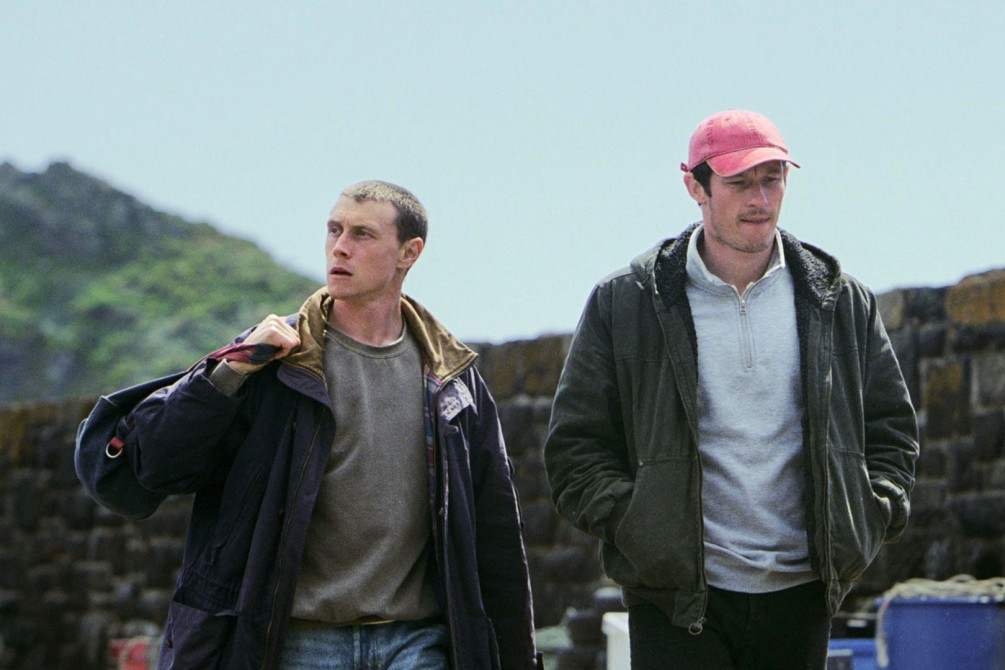

Image courtesy of 1-2 Special.
ROSE OF NEVADA— 2 STARS
LESSON #1: TEXTURES CREATE MYSTERY— So often in movies, texture can aid in telling a mystery. Polish something up to a heavy, glistening shine, and viewers will question how it can look so perfect. Maybe that perfection is so good, it looks out of place. The classic cuboid monolith of 2001: A Space Odyssey is a prime example. That also works in the other direction. A great enigma could be hiding underneath layers of flaws, acting as camouflage. Take the enchanted mask granting reality-bending powers from The Mask. With Rose of Nevada, notable experimental film director Mark Jenkin (Bait, Enys Men) is channeling the many benefits of texture.
From the get-go, Mark Jenkin, working also as his own cinematographer, made the inspired choice to shoot Rose of Nevada exclusively on 16mm film. Its crude grain and its range of stressed and saturated colors and shadows give the entire proceedings a tremendously dated—and borderline—feel. For many cinephiles, young or old, it’s likely been a while since you’ve absorbed two hours of 16mm texture, 100% post-production sound work, and the matching editing to blend that all together, making this presentation a bit of a feast and treat for the purists out there who despise the current flatness of digital cameras and projection.
Jenkin offers a story that fits that feel. One day in a village in the county of Cornwall in southern England, a small fishing vessel that hadn’t been seen in thirty years appears tied to a dock. While the boldly red ship is plenty weathered—pocked with flaking paint mixed with rust and coated in its share of crustified ocean grit—it looks the same as the day it disappeared in 1993, much to the surprise of Mike (Edward Rowe of The Witcher and House of the Dragon), the local boss who used to own the boat decades ago. Walking its deck and examining its holds and remains, all the astonished man can say is, “She’s back.”
This rediscovered boat is the first of many textures provided by the props and sets in Rose of Nevada. Its dank surfaces and venerable imperfections create a lived-in feel you can almost touch, smell, and damn near taste next to the salt-tinged coastal air blowing against it. Pair that with the hint of its disappearance—and now reemergence—and those dingy surfaces now carry a mystique that guides the potential of a story, one you feel right away in the film.
The beginnings of that tale come from the locals who remember the incomplete story of the titular fishing boat. Billy Richards (Adrian Rawlins of Chernobyl and the Harry Potter series) and his senile wife (veteran TV star Mary Woodvine, who is also granted story idea credit with Jenkin) lost their son, Luke, to suicide over his grief from staying behind and losing his mates on the boat’s final trip. Billy still visits the high cliff his son jumped from to lay bouquets of red carnations. Nick Dyer (1917’s George McKay) is married to Tina (Slow Horses ensemble member Rosalind Eleazar), who lost her father at sea as a member of the Rose of Nevada crew. He knows the tragedy well.
Since the presumed accident of the Rose of Nevada, tough economic times followed, and the fishing business dropped off considerably. With a new asset back in hand, Mike rebrands the recovered boat and puts it back into service. Short on income with necessary home repairs over his head (literally from a leaky roof), Nick takes the fisherman work on the boat for a sauced old skipper named Murgey (Francis Magee, last seen in 2024’s The Damned). Rounding out the hired three-man crew is the unemployed derelict Liam (heartthrob Callum Turner), who sleeps on the dock.
One of the first things Nick notices milling around on the former Rose of Nevada, learning its routines and functions, is the sentence, “GET OFF THE BOAT NOW,” carved into a bedrail. Coupled with a rough and nervous synthesizer score created by Jenkin himself—acting all John Carpenter Lite, that omen should have been his second warning (and ours after the return of the boat), that all is not what it seems in this situation, and Jenkin’s burgeoning mindbender. Maybe the actual second warning was seeing The Dead Zone, David Cronenberg’s famous 1983 sci-fi thriller, playing on a TV a little earlier.
LESSON #2: BEND THE PASSAGE OF TIME— Either way, once Nick and Liam leave the harbor for a fishing trip, Rose of Nevada bizarrely turns back the hands of time. When they return with Murgey after a successful three-day fishing trip, it’s 1993, not the present day. Everyone, from Mike and the Richards couple, is younger and in different stages of life. Even more disturbing, no one recognizes Nick and Liam as who they are. They think Liam is Alan, Tina’s future lost father, and Nick is Luke Richards, years before his eventual suicide.
The rudderless Liam, now rolling with a steady paycheck and a doting spouse, is more than happy to play house and keep on fishing in this new timeline, ignoring his lost present where he was a nobody. The opposite reaction comes to Nick. Thanks to the generous parental attention he receives from Mr. and Mrs. Richards, he carries distressing guilt over what he’s missing back in his time and longs for the family left behind that needs him. Between the two, Nick’s the only one willing to test the boundaries and figure out when and what is going on with the Rose of Nevada as it gets closer to the date when it was lost at sea.
As aforementioned, the premise of Rose of Nevada, bobbing our two strapping young men to the mercy of the seas of time, carries the “potential” of a story. Unfortunately, potential can only reach so far without actual progress. Try as George McKay can to unravel with his wide eyes to find an exit for Nick from this spiral, the oddness and downright tediousness of the plot never reach a true mindfuck level. Even when he, as the imagined Luke, becomes the one scrawling that warning into the wood back in time, suggesting Jenkin is meshing a ghost story of repeated or shared fate with the time loop narrative, the dull barbs do not puncture enough psyches to rattle us watching. We need more winks or chin rubs than a Christopher Walken easter egg, rich film stock, and an open ending of weak doldrums to put us on pins and needles.
LOGO DESIGNED BY MEENTS ILLUSTRATED (#1405)