
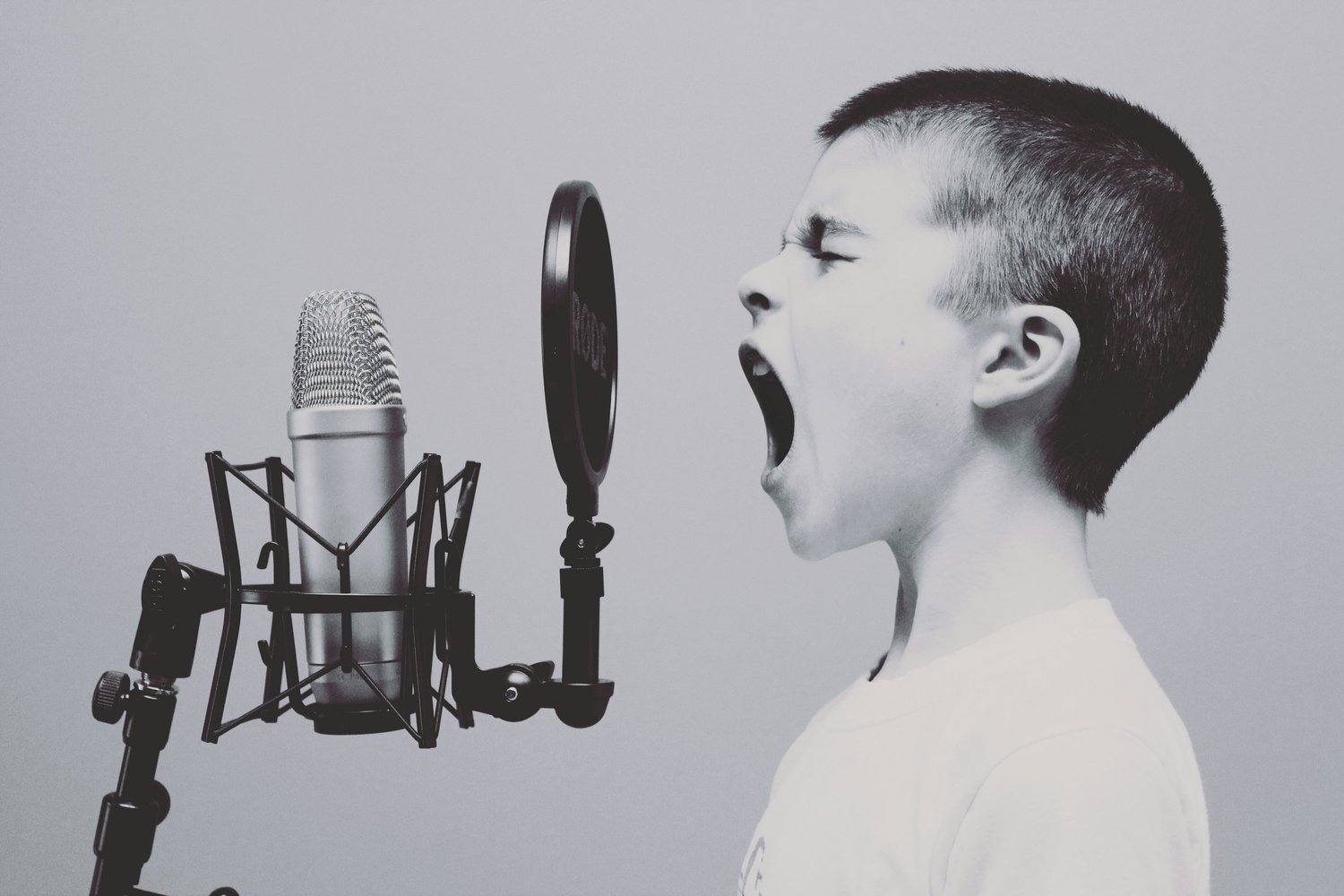

Image: Boy singing on microphone with pop filter photo – Free Portrait Image on Unsplash
Cinema has always been drawn to the moment when someone who has been silent finally speaks. Not just in the literal sense of uttering words, but in the deeper sense of being heard, understood, and able to communicate what is inside them. Some of the most emotionally powerful scenes in film history are built around this single, universal human experience.
What these films understand — and what researchers in speech and language development have confirmed — is that communication is not just a functional skill. It is the foundation of identity, connection, and belonging. When it is lost, limited, or delayed, the impact reaches far beyond the words themselves.
The King’s Speech: Courage in Every Syllable
Tom Hooper’s 2010 film remains one of the most celebrated explorations of speech difficulty in cinema. Colin Firth’s portrayal of King George VI — a man carrying the weight of an empire on shoulders already burdened by a debilitating stammer — is a masterclass in what it means to fight for your own voice.
What the film gets right, beyond the historical drama, is the therapeutic relationship at its heart. Lionel Logue, the unorthodox Australian speech therapist played by Geoffrey Rush, does not fix the King. He gives him a safe space to fail, to practise, and to gradually reclaim a voice that anxiety and childhood trauma had suppressed. The lesson is not about the stammer disappearing. It is about the courage to speak anyway.
For anyone who has watched a child struggle to form words, or an adult relearn speech after a stroke, this film resonates with a truth that transcends its royal setting: finding your voice is never just about the mechanics of speech. It is about being seen, heard, and supported by someone who believes in your ability to communicate.
The Diving Bell and the Butterfly: Communication Beyond Words
Julian Schnabel’s 2007 film tells the extraordinary true story of Jean-Dominique Bauby, the editor of French Elle who suffered a massive stroke and was left with locked-in syndrome — fully conscious but able to move only his left eyelid. The film, narrated from entirely inside Bauby’s perspective, is a profound meditation on what communication means when the body fails.
What makes the film remarkable is how it challenges our assumptions about what speech is. Bauby communicates an entire memoir — blinking out each letter one at a time — with the help of a patient assistant who reads through the alphabet until he signals the right letter. It is painstaking, exhausting, and utterly extraordinary. And yet it demonstrates something every speech and language therapist understands deeply: the drive to communicate is one of the most fundamental human instincts. When one channel is blocked, people find another.
The film is a lesson in patience, in alternative communication, and in the absolute refusal to be silenced by circumstance. It is also, quietly, a tribute to every professional who has ever sat with a patient and helped them find a new route to expression.
Finding Dory: Memory, Repetition and the Kindness of Patience
Pixar’s 2016 sequel to Finding Nemo addresses communication challenges in a way that is accessible to younger audiences without being simplistic. Dory’s short-term memory loss creates a specific kind of communication difficulty — she cannot hold the thread of a conversation long enough to follow it through. She loses context, repeats herself, and struggles to process the sequential information that most communication depends on.
What the film does beautifully is show the difference between the people in Dory’s life who accommodate her difficulty and those who find it frustrating. Marlin’s gradual journey from impatience to genuine understanding mirrors what families and educators often experience when supporting someone with a communication challenge. The lesson is not about curing Dory. It is about adjusting expectations, building strategies, and recognising that a different communication style is not a lesser one.
For parents of children with speech, language, or memory difficulties, this film lands with particular emotional weight. It names the exhaustion, the love, and the moments of unexpected breakthrough that define those relationships.
Children of a Lesser God: Challenging What Communication Means
Randa Haines’ 1986 film remains one of the most thoughtful explorations of Deaf identity and communication in mainstream cinema. The central conflict between James Leeds, a speech teacher who wants his Deaf student Sarah to learn to speak, and Sarah, who refuses to abandon sign language as her primary mode of expression, is not just a romantic tension. It is a profound argument about whose definition of communication gets to be considered valid.
The film asks an uncomfortable question that is still being debated in education, therapy and Deaf communities today: when we insist that someone communicate in a particular way, whose needs are we actually serving? Sarah’s resistance is not stubbornness. It is a defence of her identity and her community. The lesson is one that professionals in speech and language therapy continue to grapple with — that the goal of communication support is not conformity but connection.
Marlee Matlin won the Academy Award for Best Actress for her performance, becoming the first Deaf performer to win in that category. The film remains essential viewing for anyone working in or thinking about communication, language, and the politics of difference.
What These Films Have in Common
Across genres, decades, and very different storytelling approaches, these films share a core conviction: that the ability to communicate — to be understood by another person — is not a luxury. It is a fundamental human need, and the absence of it creates a specific kind of loneliness that other comforts cannot fully address.
They also share a belief in the transformative power of the right support. Whether it is a royal speech therapist in a basement flat in London, a patient assistant blinking through an alphabet, a fish with an unconditional friendship, or a Deaf woman refusing to be defined by hearing standards — each story centres on the relationship between someone struggling to communicate and someone willing to meet them where they are.
That principle is at the heart of good speech and language therapy. Not the imposition of a standard, but the collaborative search for a way to connect.
The Real-World Lesson
Films hold a mirror to experiences that many people are living quietly, without the dramatic backdrop of a royal broadcast or a locked-in syndrome recovery. Millions of children around the world are navigating speech delays, language disorders, stammering, autism-related communication challenges, and hearing difficulties. Millions of adults are relearning speech after strokes, managing voice disorders, or supporting family members through these experiences.
The lesson these films teach is not just for the screen. It is that early, compassionate, and skilled support makes an enormous difference. That the right therapist, at the right time, with the right approach, can change the trajectory of a life. And that communication — in whatever form it takes — is worth fighting for.
If you or someone you know is navigating a speech, language or communication difficulty and is looking for professional support, click here to find out more about the certified speech therapy, physiotherapy and audiology services available at Speech Rehab Clinic in Islamabad and Rawalpindi — where every patient’s voice matters.