

Images courtesy of Greenwich Entertainment
OMAHA— 4 STARS
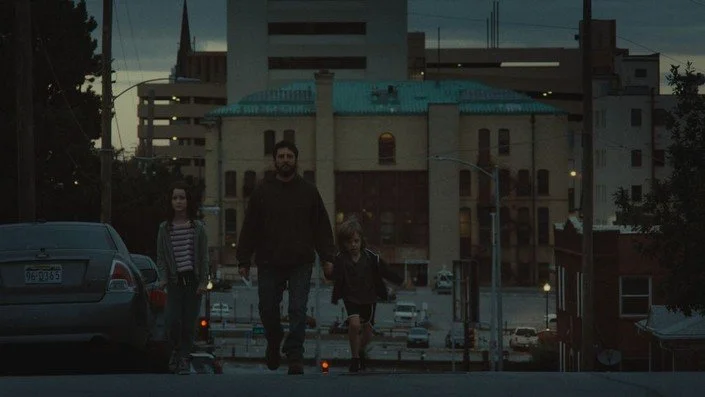
Omaha, the feature-length directorial debut of short film specialist Cole Webley, opens with a single father in Nevada, played by indie darling John Magaro of First Cow. After awaking before dawn, he’s rousing his two kids—one younger boy, Charlie, and one older girl named Ella—and the family’s golden Labrador, Rex, for a morning departure. For whatever reason, this is the morning he’s set for leaving this home behind, as he asks his children to pack what they can carry as if they were limited to what they could save in the event of a fire.
That oddly specific parental instruction gives Ella (Molly Belle Wright) pause, where she puts a little more consideration into what is going on. Unlike her brother (Wyatt Solis), packing a handful of toys, her choices become more mindful. As Omaha’s camera follows the father moving items from the house to the car parked outside, the unmistakable shape and placement of an eviction notice taped to the glass of the screen door becomes the next telling clue, as does the John McCain campaign sign in a window to give this setting an unofficial 2008 timestamp.
LESSON #1: THE PAIN OF LEAVING HOME— This will be the last time these kids see this house. It could very likely be the sole home they were raised in. It’s most definitely the place they remember their late mother. Omaha doesn’t dump verbal exposition to announce this grand departure. It is shown wordlessly with the uncomfortable body language of anguish in Magaro’s father. He’s trying to hype this up as a fun road trip, when it, deep down, is anything but that. Ella finally says it out loud to reassure her brother: We’re moving.
The tone of this moment changes again when a sheriff pulls up to have—from our and the children’s perspective—a squelched conversation with Magaro. Even though we don’t hear the words, it’s the final chunk of dignity the father had remaining for this home. After some teamwork to roll their shabby Toyota station wagon down the street to gain a little starting inertia, Omaha is off down Interstate 80 east towards any range of unknown fates. In this short time, the competing feelings of the eagerness within the children and the inescapable dread carried by the father lock the audience in its own seatbelt for this poignant and understated journey.
The title of the film reveals the desired end destination for Magaro’s matriarch. The pleasant Nevada weather allows the windows to be rolled down and burned CDs to blare old family favorite songs. Smiles sneak in to make Omaha a proper road movie with a glimmer of hope.
LESSON #2: INESCAPABLE REALITY— Yet, for every blissful moment of optimism in Omaha granted by the long highway carrying them to the Great Plains, reality remains inescapable in both the rear-view mirror and the windshield aimed forward. Anytime the family stops, the father is restricted by his limited cash, dwindling welfare benefits, and a lack of other credit cards. When two doting children want a meal, a motel with a pool, or the dalliance of a gas station toy, tough and unpopular monetary decisions have to be made. When they’re parked for a break, they play, and he ponders.
LESSON #3: THE PARENT LINE OF “IT’S FOR THE BEST”— The dad talks about work, opportunity, and a new start there, but we can’t tell if it’s the truth or something he’s telling the kids—and maybe himself—to keep their collected spirits up. He does what many parents have done for decades by dropping the line of “It’s for the best.” In this plight, Omaha gauges what moments bring forth that axiom and what type of parents use that line to begin with. The film holds for the reactions of a kid’s interpretation of that overused excuse through a pair of exceptional child performances from Wright and Solis. To them, desperation looks like punishment.
The closer Omaha gets to its terminus in the Cornhusker state, those spending choices from Lesson #2 get harsher, and the demands for mere children to mature with responsibility on the spot, fitting Lesson #3, get more sensitive. Those watching who are parents or are old enough to remember the sweeping financial crisis of the Aughts know the parallel paths on display of sadness and fear all too well. The intimacy of it all, happening often with the four doors of a car, punches your observant and invested conscience.
You want that aforementioned glimmer of hope to win, but the uncertainty written by Robert Machoian (The Killing of Two Lovers) is overwhelming. When you ask how someone could do the things you see transpiring in Omaha, the true strategic and historical answer isn’t revealed until the closing credits. However, the agony conveyed by John Magaro tells enough about the emotive reasons and the weight of reconciling these types of fateful decisions.
For the most part, all eyes are on the Past Lives and September 5 co-star as the unnamed-until-the-very-end Martin Harper. Magaro’s slight voice, heavy brow, and shaggy beard house his inner crumble. Watching him go through this torment, the actor’s character does not shed tears. It’s not because Martin is heartless or that Magaro doesn’t have the capacity. It’s because the father and the actor are holding on so hard to each scene and formative family moment. That immense sense of parental grip is everything for Omaha and demands your attention, respect, and empathy.
LOGO DESIGNED BY MEENTS ILLUSTRATED (#1390)