

Images courtesy of Trafalgar Releasing
THE OPTIMIST— 4 STARS
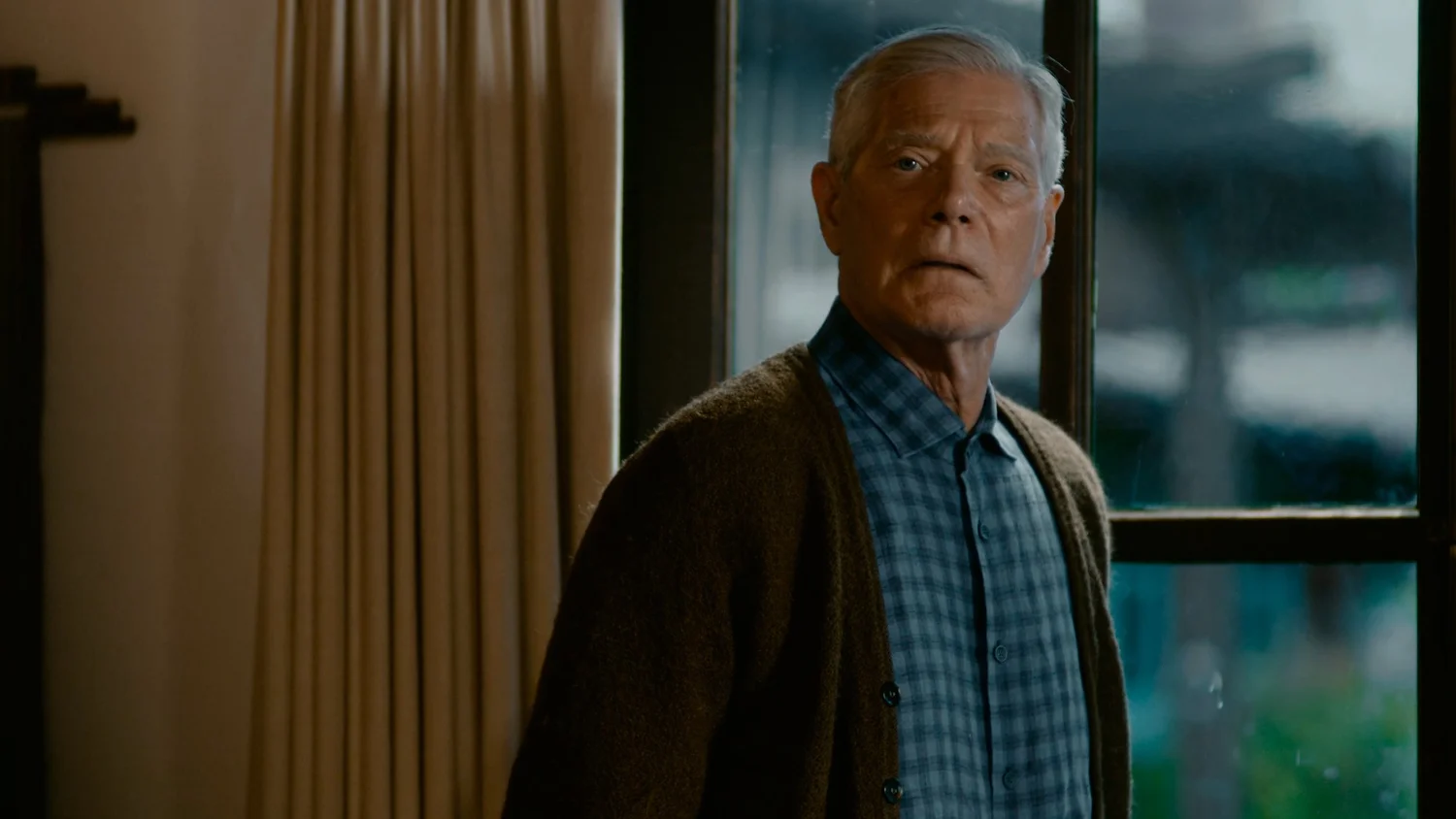
In The Optimist, Stephen Lang plays Herbert Heller, the amiable owner of a children’s toy store in San Rafael, Marin County, California. He’s received the worst kind of stock line of bad news from his physician: “You should begin to get your affairs in order.” Herbert doesn’t tell his family of the prognosis and immediately begins a store closing sale at his shop. He’s happy to pass out European chocolate treats and commiserate with old and new customers when an unexpected trigger arrives that takes away his jovialness.
When a local policeman approaches Herbert about crowded parking issues with the influx of customers from the sale, Herbert cannot help but fixate on the leather accouterments of his uniform, particularly his clean, shiny black boots. His breath quickens, and his mind races. For a moment, the guise of the kindly cop morphs into a memory of a menacing Nazi officer in full uniform of his own. The innocent encounter ends, and Herbert excuses himself to calm down. This is The Optimist’s harrowing first glimpse into a painful former life.
As it turns out, Herbert’s current health status isn’t the only thing he has never told his wife and three daughters—or anyone else, for that matter—in this 2004 setting. This unassuming senior citizen is a survivor of two World War II concentration camps, including the infamous Auschwitz-Birkenau. Folks, there is, undoubtedly, a worthy story waiting to be told in The Optimist, and a true one at that. This fine film from writer-director Finn Taylor brings it forward with poignant grace.
Staring down mortality in The Optimist, Herbert has decided that he needs to speak his testament. While it’s still too much for him to discuss in front of his beloved family, he has arranged to be recorded on video by a local counselor, Ruth (former Deadwood star Robin Weigert). Enlisted to help Ruth with the equipment and interview is a troubled local teen from her caseload named Abby, played by the outstanding Elsie Fisher of Eighth Grade and the upcoming Tow. She comes from a turbulent, divorced home and harbors a tremendous level of guilt from an as-yet-unrevealed recent incident involving the death of her classmate and friend Sabrina (Ursula Parker).
While nervously preparing to be on camera, Herbert takes mindful notice of Abby and her bandages. At the same time, she asks him about a pronounced scar on his wrist from where, we can only imagine, a tattoo of registration numbers used to be. He says his mark is a long story and assumes the same about her. He convinces her—a scar for a scar—to trade stories. It’s almost like he knows this girl needs to talk as much as he does.
LESSON #1: THE DISARMING POWER OF SHARING EXPERIENCES WITH STRANGERS— Among many strong themes, The Optimist demonstrates the disarming power of sharing experiences with strangers. On paper, these two lead characters couldn’t be more different in stature and backgrounds. Yet, together—and for the benefit of the video project—they bond over trauma, proving that the conditions for this kind of success require a willing talker and an similarly willing listener. Fisher and Lang grow that mutual rapport earnestly and wonderfully.
LESSON #2: SHEILDING CHILDREN WITH OPTIMISM— As Herbert tells his history, The Optimist flashes back to 1940s Prague, where his respected engineer father Karel (Slavko Sobin of The Old Guard 2) and saintly mother Melanie (The Good Liar’s Stella Stocker) strive valiantly to match the mentality of the film’s title. Deflecting the gossip and speaking only of good things, Karel shields the growing atrocities from young, 15-year-old Herbert (Luke David Blum of The King of Staten Island) and his oldest son Hein (Brothers’ Oskar Hes). Even as they are run out of their home by the Gestapo and placed in the Terezin concentration camp, the instilled stance of optimism would go on to keep the Hellers alive longer.
Though it may champion and wear its titular mindset proudly next to its sewn-on yellow Stars of David, The Optimist does not try to soften or sugarcoat the cold, agonizing truth of its conveyed history, even when it descends to the hells of Auschwitz. Running parallel to Herbert’s reminiscences are Abby’s fresh tragedies, which carry their own difficult darkness. While the film is not rated, the hard violence, which happens in the echoes and fringes of the main imagery, is kept to what would be a still-stern PG-13 level. That tonal restraint from Finn Taylor creates a keen accessibility to welcome wider and necessary teen audiences. This is an justifiable parent permission slip away from being classroom-essential viewing for those history teachers out there.
Commensurate with the astonishment of Heller’s tale is the revelatory work from Stephen Lang. Known by most for playing the militaristic heel of the Avatar franchise, Lang exudes all of the aforementioned adjectives—amiable, jovial, genteel, willing, unassuming, mindful—in one of the most unexpected and award-worthy performances in recent memory. Eschewing his hardass tendencies, the actor uses his square jaw, piercing blue eyes, pressed wrinkles, and silvered buzzcut to play a pillar of empathy doing his best to wring himself of excruciating and unhealed fear.
Even greater, Lang does so, opening the space to someone two generations younger in Elsie Fisher. The back-and-forth narrative structure of The Optimist hides the two locked chests of secrets held by the Herbert and Abby characters for as long as possible, granting Elsie dramatic opportunities to spellbind viewers with her own demons to dispel. Her role could have easily been the stereotypical petulant and ignorant teen, oblivious to the depth of real hardships or loss, getting schooled by the finger-wagging old man delivering monologues who’s actually lived something substantial. Instead, The Optimist refreshingly makes Fisher’s character a dynamic equal.
LESSON #3: SURVIVOR’S GUILT— By the time the twin narrative tapestries of The Optimist come together and form their parallels, survivor’s guilt becomes the shared plight between our two struggling protagonists. Unshy with its sorrow, the film finds lift in showing one person helping another see why they survived when others they care for did not. There’s an aim to making choices for how one can and should endure after hurtful losses, and it starts with forgiving yourself. Hopeful and reflective lessons like that—delivered with dignity and put to film for impressionable audiences—will always have a vital place for thoughtful entertainment.
LOGO DESIGNED BY MEENTS ILLUSTRATED (#1379)