

Iraq is a country full of history, culture, and amazing stories from the past. It is one of the oldest places in the world where people built cities and started early civilizations. Over time, many great empires lived here and left behind beautiful monuments and historical sites. From ancient ruins and old temples to famous mosques and shrines, each place has its own story. Many of these places are thousands of years old and still stand today, showing the deep history of Iraq. Visiting or learning about them feels like going back in time and discovering something new and interesting at every step.
Here are some of the most famous monuments and historical sites in Iraq that highlight the country’s rich past.
Babylon – A Legendary Ancient City
Babylon, a famous ancient city in Mesopotamia (modern-day Iraq) often called “Gate of the Gods,” served as a powerful center of culture, learning, and trade along the Euphrates River, known for its impressive architecture, such as the grand Ishtar Gate and its possible connection to the Hanging Gardens, one of the Seven Wonders of the Ancient World. It flourished under rulers such as Hammurabi, who introduced one of the earliest written law codes, and Nebuchadnezzar II, who expanded and beautified the city, making it a symbol of great power and advancement in fields such as mathematics, astronomy, and trade. However, Babylon’s importance gradually declined when it was conquered by the Persians under Cyrus the Great in 539 BC.
Today, Babylon is a UNESCO World Heritage Site and one of Iraq’s most important archaeological sites.
The Ziggurat of Ur – A Temple of the Sumerians
The Ziggurat of Ur is one of the most well-preserved sites of ancient Mesopotamia. It was built in 2100 BCE when Ur-Nammu was the king. This huge stepping pyramid was dedicated to the moon god Nanna. Unlike Egyptian pyramids, which were built as tombs, ziggurats were religious buildings, where priests worshipped and carried out rituals.
The Ziggurat of Ur is another testament that proves the high level of Sumerian Civilization. The invention of early writing systems, mathematics, and city life is attributed to the Sumerians. Even now, the monument is still an impressive display of ancient engineering and religious buildings
Nineveh – The Capital of the Assyrian Empire
The ancient city of Nineveh was once the capital of the powerful Assyrian Empire. It was located near modern-day Mosul. During the rule of Sennacherib and later Ashurbanipal, Nineveh became a major political and cultural center. One of its greatest discoveries is the Library of Ashurbanipal, which contained more than 30,000 clay tablets written in Cuneiform.
These tablets included historical records, religious texts, and literature. Notable among them was the famous Epic of Gilgamesh, considered one of the oldest surviving works of literature.
Hatra – A Fortress City in the Desert
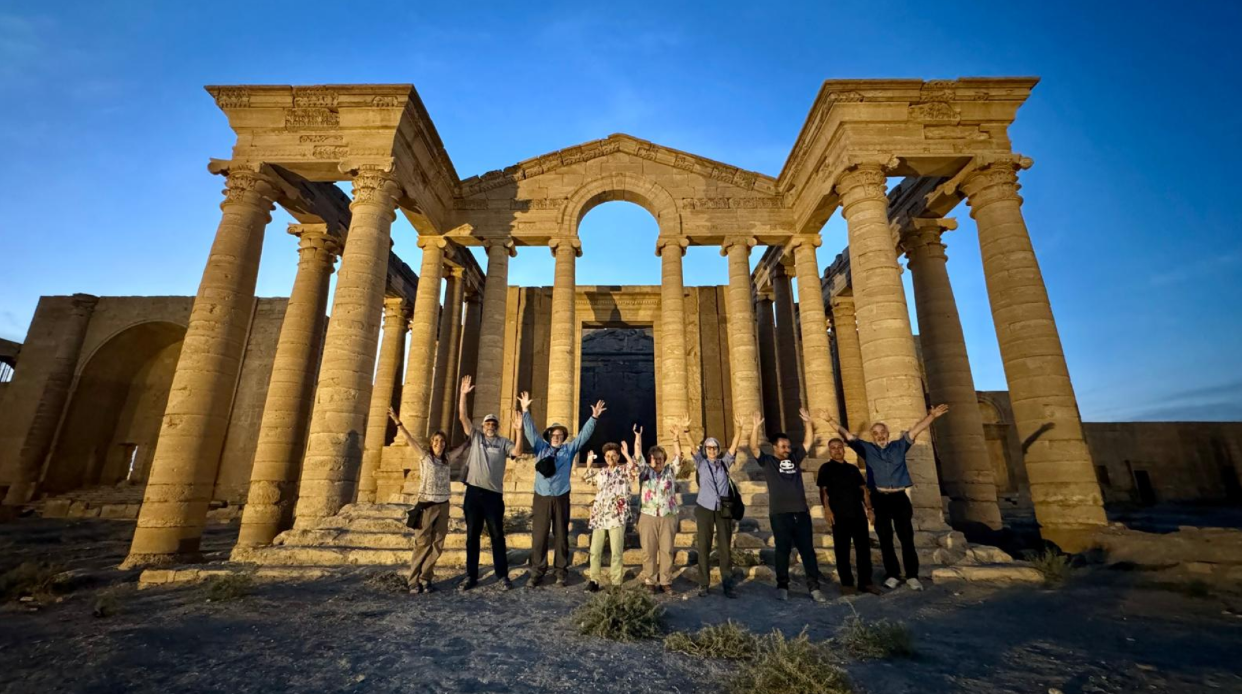
Hatra is an ancient fortified city in northern Mesopotamia (modern-day Iraq) that served as a major religious and trading center, known for its strong walls, distinctive architecture, and blend of diverse cultural influences. It flourished during the Parthian Empire and became famous for its large temples dedicated to various gods, showing a mix of Greek, Roman, and Eastern styles.
The city was well protected by thick defensive walls and towers, which helped it resist invasions by powerful empires such as the Romans. Because of its location on important trade routes, Hatra became wealthy and culturally diverse. Hatra was later abandoned after being conquered by the Sassanian Empire in the 3rd century AD, though its ruins still stand as an important example of ancient architecture and history.
The Great Mosque of Kufa
The Great Mosque of Kufa is one of the oldest and most important mosques in the Islamic world, located in the city of Kufa in Iraq. It was originally built in the 7th century during the early period of Islam. The mosque is especially famous because it is closely connected to Ali ibn Abi Talib, the fourth caliph of Islam. He made Kufa his capital, and the mosque became a center for religious, political, and educational activities.
One of the most significant events linked to this mosque is that Ali ibn Abi Talib was fatally injured here while praying in 661 CE. Because of this, the mosque holds deep spiritual importance, especially for Muslims. The mosque has been rebuilt and expanded many times over the centuries. Today, it features large courtyards, domes, and beautifully decorated prayer halls. It can accommodate thousands of worshippers and is also a popular place for pilgrims.
Ctesiphon – The Ancient Persian Capital
Ctesiphon, a historic city located on the eastern side of the Tigris River, was the capital of both the Parthian and the Sassanid Empires. It was a significant political, economic and cultural hub of ancient Persia. The city has earned fame with Taq Kasra, the large brick arch, which is one of the largest single-span arches in the world. The historical significance of the city has been traced through grand palaces, bustling markets, and beautiful temples that have been discovered by archaeologists. Ctesiphon was taken over by the Romans, Arabs, and other armies over the centuries, which demonstrates the strategic importance of the city. Nowadays, it is a representation of ancient Persian architecture and is a point of interest to both historians and tourists.
Sulaymaniyah – The Cultural Heart of Kurdistan
In the Kurdistan region, the town of Sulaymaniyah, established in 1784 by the Kurdish prince, Ibrahim Pasha Baban, is commonly referred to as the City of Culture. The city boasts of vibrant cafe life, tasty Kurdish food, and great artistic traditions. There are numerous libraries, theaters and art galleries, which is why it is a center of education and arts. Sulaymaniyah also has high-profile festivals, including the Sulaymaniyah International Film Festival, which attracts international artists and visitors. The city itself is also surrounded by natural sightseeing sites such as the Goyzha Mountain and Alan Valley, which attract tourists and photographers who enjoy hiking and the view.
Zakho – A Historic Trade City
Another city that has traditionally been a trading hub is Zakho, located close to the border between Iraq and Turkey. The city has a very popular landmark, the historic Delal Bridge spanning the Khabur River. Kurds, Assyrians, and Arabs have lived in Zakho for centuries, forming a multicultural atmosphere. The city also has vibrant markets where tourists are able to purchase the local products, spices, and fabrics. Zakho is a good place to visit and enjoy the outdoors, as the area is encircled by valleys and hills. The city hosts festivals and cultural occasions that help people explore the culture of various communities and have a distinct idea of the local life.
Conclusion
The Iraqi monuments and historical sites are a symbol of one of the earliest human civilizations. From the mythical city of Babylon to the impressive Ziggurat of Ur, these sites narrate the story of great empires, religious traditions, and outstanding architecture. Preserving and studying these landmarks helps us understand how early civilizations developed cities, knowledge, and culture that continue to influence the world today. For travelers interested in history, culture, and heritage, Iraq offers a journey into the very beginnings of civilization.