
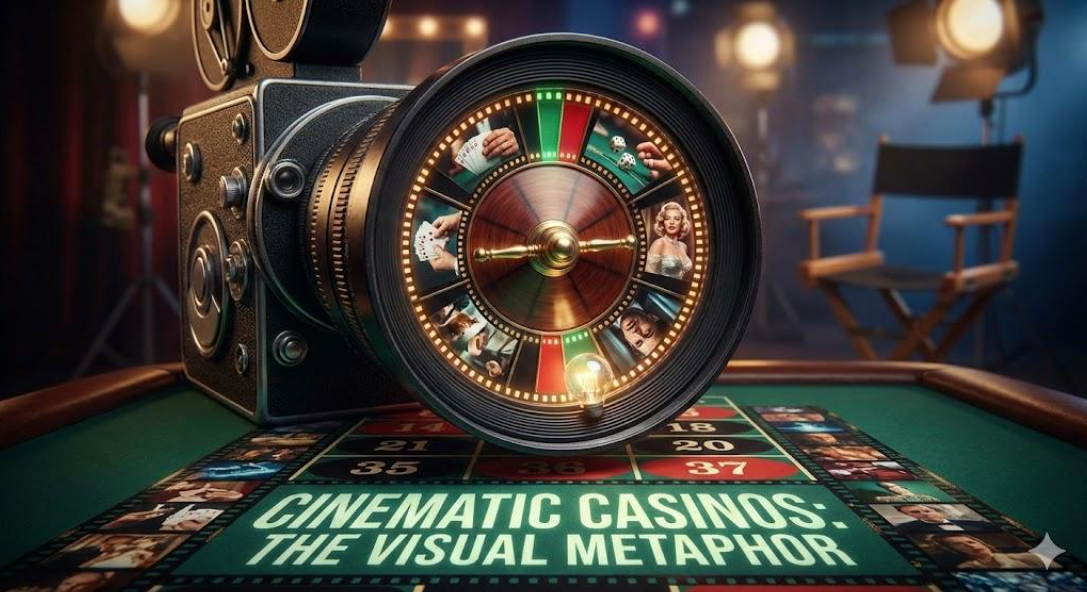

Image credit: Gemini
There are hardly any objects in the entire visual language of the motion picture arts that are endowed with an unconscious dramatic gravitas and psychological significance, as is the roulette wheel. It is, literally, a perfect circle with a disorganized number within it,t a binary topography of red and black that functions solely according to the horrific, cold laws of physics.
In contrast to poker, which depends greatly on the psychological armament of the bluff and the interpersonal relationship of the players, or blackjack, which calls upon mathematical tactics and card counting, roulette is an individual, existential struggle between human desperation and the universe itself. The silver ball does not identify any plot line; it does not follow any character line. It just crashes down, ruled by gravity and momentum, an impartial determiner of destiny.
However, in almost a hundred years, artists have been projecting human will, existential fear, and deterministic philosophy onto this number generator of random numbers and turning it into the ultimate visual metaphor of fate, risk, and the instability of the illusion of human control. With the changing cinematic landscape being transformed into 2026, the image of the roulette wheel has been changed significantly. We shall take a closer look at the advanced cinematography, new sound effects, and deep symbolism in storytelling of the roulette wheel in both old films and the contemporary period of gambling films.
The Evolution of the Cinematic Gamble: From Mastery to Chaos
In order to completely deconstruct the current cinematic application of the roulette wheel, it is necessary to initially follow the history and semiotic development thereof. The position of the camera to the wheel has changed fundamentally over the decades, reflecting the changes that happened in society in the ways of defining luck, morality, and systemic power in the eyes of the audience.
The Romantic Ideal and the Illusion of Mastery
In early film, the wheel was often used by the filmmakers to symbolize the universe where the unshakable virtue or sheer charismatic power could literally bend the rules of probability. The casino was used in this period to bring to the fore a final domination by a protagonist over his environment.
The second example of this phenomenon can be observed in the film Casablanca (1942) by the iconic movie director, Michael Curtiz, through the so-called benevolent fix. In one of its most important scenes, Rick Blaine (Humphrey Bogart) arrives at his rigged roulette table to assist a desperate young couple to escape the Nazi-infested.
Europe. He tells the husband to bet his number 22. Miraculously, the wheel falls on 22 twice in succession.
Mathematically speaking, the chance of striking twice in a row on a single-zero European wheel is 1 in 1369 or about 0.07%. Here, the wheel loses absolutely its purpose as a tool of blind destiny. Rather, it is directly a continuation of the subconscious moral compass of the main character.
This absolute mastery theme developed in the middle of the century when the James Bond franchise institutionalized the roulette wheel as a place of masculine superiority. In Diamonds Are Forever (1971), Sean Connery’s Bond hits 17—an astonishing 1 in 50,653 statistical anomaly based on Connery’s real-life legendary winning streak. It is not a mathematical riddle to Bond, the wheel; it is simply an extension of his physical and mental superiority.
The Metaphysics of Chaos and the “God’s Eye” View
With the development of the cinema in the late 1990s and the early 2000s, the visual metaphor has aggressively transformed into the dominance of metaphysical anarchy as opposed to the sense of romance. The high-octane thriller Run Lola Run (1998) by Tom Tykwer is the direct opposite of James Bond. Rushing along with a twenty-minute alarm, Lola lets out a glass-shattering scream that literally throws the ball down the 20 pocket. The wheel in this case represents a multiverse of extreme possibilities that are chaotic, and the human desperate extremes are trying to bend the immutable laws of physics.
Cinematographers invented the so-called God’s Eye view in order to express this change in human control to cosmic indifference. This extreme overhead shot, which is widely used in movies of Run Lola Run up to the pessimistic neo-noir Croupier by Mike Hodges (1998), is viewed directly down on the spinning wheel. It thoroughly flattens the depth of the field and makes the three-dimensional, complicated wheel a two-dimensional, geometrical abstraction. It constantly reminds the viewer that the universe is governed by cold mathematical certainties in an elevated, non-touchable point of view.
The Binary of Ruin
When all the supernatural elements of the willpower or the heroic elements of the spy are thoroughly removed, the role of the roulette wheel becomes a mere machine of destruction. In Indecent Proposal (1993) by Adrian Lyne, a ruined couple bets all that it has on Red, but the ball falls on Black. The wheel has been created as an emotional and financial vacuum that deprives the characters of their agency withina fewe seconds. The dichotomy of the game Red or Black is a perfect reflection of what lies ahead of them: to face the prospect of total financial destruction or to give in to moral decay.
Welcome to 2026: “Macau Noir” and Tactical Paranoia
With the cinematic chronology shifted to 2026, the geographical, aesthetic, and thematic nodes of the casino thrillers have shifted considerable distances. The Art Deco classical elegance of Las Vegas in the middle of the century has been much replaced by wet, neon-soaked hyper-capitalist conditions of Asian gaming capitals to produce the specific subgenre of Macau Noir.
The upcoming slate of 2026 thrillers is characterized by raw psychological examinations of addiction, systemic corruption, and the gamification of violence.
The Internal Gamble: The Ballad of a Small Player (2026) by Edward Berger is a pop opera that was highly anticipated. After an exiled British lawyer (Colin Farrell) stalks the casino floors in Macau with a tarnished reputation, the camera floats the screen with hyper-saturated neons before choking it with claustrophobia. The movie brilliantly shows that to the actual addict, it is not about money anymore; it is just about staying in the error state of danger.
The Systemic Gamble: The Rip (2026) is a neo-noir by Joe Carnahan that transfers the rules of the casino into the Miami police. The gamble is highly tactical; the narcotics detectives have to bet on their loyalties and lives using the partial information. The torture of having to wait to see criminals do it is similar to the torture of waiting admiringly until the croupier says no more bets, and the silver ball descends.
The Biological Gamble: Bet Dead Casino (2026) exploits underground UK fighting pits, in which being alive is the bet, a wider idea of the general trend in cinema where life and death are commodified as entertainment.
The ASMR of Risk: Sound Design as a Secondary Narrator
The movie’s strength of the casino scene requires much more than the visual range. Sound design serves as the second narrator in contemporary thrillers. The audio engineers have mastered a unique acoustic envelope, which exploits human physiology, relying heavily on ASMR (Autonomous Sensory Meridian Response) to produce visceral tension.
The ADSR Envelope of the Spin
A meticulously crafted cinematic roulette scene follows a strict ADSR (Attack, Sustain, Decay, Release) envelope:
Attack: This is triggered by a very strong and commanding signal, the call by the croupier to place your bets. This slices through the surrounding noise in a sharp way, requiring instant focus.
Sustain: The ambiance becomes larger to include the deep hum of the casino. Sound designers overlay the sounds of crowds in the distance with the rhythmic and satisfying clink of the casino chips that create the illusion of huge wealth.
Decay: It is the critical emotional turning point in the case of Rien ne va plus (“No more bets”). The ambient hum is rudely silenced, and the scene sinks into the vacuum of silence. There is nothing but the buzz of the silver ball as it races over the rim, with its mechanical sound.
Release: There is a break of tension in the violent, staccato clack-clack-clack of the plunging, ricocheting ball. This moment is often extended by sound editors by increasing the number of bounces digitally to simulate a subjective experience of time expansion at the point of an adrenaline rush.
In the cinema of 2026, the filmmakers will use ASMR interruptions to trigger deep anxiety. Sound designers avoid intellectual processing of the audience and communicate directly to the autonomic nervous system by isolating the tactile sounds of the casino. A roulette wheel made of solid wood is much deeper and richer-sounding than a metal wheel, which has a much sharper and abrasive quality and increases the sense of aggression and detachment.
The Rota Fortunae: The Circularity of Tragedy in Crime Dramas
Such visual repetition of the roulette wheel in the crime cinema has a strong classical philosophical background. The wheel is the contemporary, mechanical version of the Rota Fortunae – the Wheel of Fortune.
The Rota Fortunae is popularized by the Roman sage Boethius, and it is an illustration of how fate is capricious and uncaring. The goddess Fortuna turns the wheel randomly, elevating beggars into kings and plunging kings into mud. The casino in contemporary crime movies serves as the temple of Fortuna, lit with neon lights.
When one of the characters walks to the roulette table, the rotation of the wheel is the literal translation of Aristotelian peripeteia (a reversal of fortune) caused by his hamartia (fatal flaw). This tragic flaw in gambling cinema is nearly always hubris – the delusive belief that the character has the special ability of beating mathematical certitude.
The geometry of the wheel, that it is a closed circle with no beginning or ending, is the ideal captivation of the addict. Unlike in films such as Uncut Gems (2019) or Croupier (1998), where there is no real escape, a huge win just finances the next roll, making sure that the process continues without discontinuity until the eventual fall into ruin.
The Digital Abstraction of Fate
With the world moving more towards the digital age, the image of the roulette wheel has changed. The aesthetics of risk are also radically changed due to the enormous growth of Internet casinos and cryptocurrency betting. Modern movies are leaving the crowded and smoky floors behind in favor of the lonely and bright light of the smartphone screens in empty rooms.
The gamble in the digital world is limited to a single, frictionless exchange with an unknown algorithm. The physical wheel has a tactile reality substituted with a sterile and simulated RNG (Random Number Generator) animation. Nevertheless, there is tragic circularity of the Rota Fortunae. Even the physical wheel has been dematerialized into intangible code, which gives the feeling of a loss of control by the character, even more ubiquitous and insurmountable.