

Images courtesy of Walt Disney Pictures
AVATAR: FIRE AND ASH— 2 STARS
Three years ago, in this review space covering Avatar: The Way of Water, respect was paid to James Cameron for being less-than-properly heralded as “one of the best cinematic storytellers for action and emotion the medium has ever seen” and someone who “has crafted some of the most elaborate, dazzling, and iconic action sequences for decades now.” Looking over all of his career’s creations from Terminator to Titanic and beyond to his Pandora universe returning in Avatar: Fire and Ash, those weren’t light words. Like him or not, he’s in rarefied air and has earned his massive success and esteem.
LESSON #1: MAKE US CARE— Circle back for a moment to his capacity as an emotional cinematic storyteller. Through all of James Cameron’s foremost technical prowess to deliver the fantastical, he has always found a way to make us care about simple tales underneath the flashy presentation. Through two Avatar movies, he achieved that very pull, even against the Pocahontas, Dances With Wolves, and Ferngully: The Last Rainforest comparisons and criticisms. Unfortunately, that undaunted magnetism ends with Avatar: Fire and Ash. At nine hours and change into a saga daring to be a generational story that could stretch as long as seven films in the next decade, James Cameron has failed to make us care.
Compared to the 16-year storyline gap between the original and its first sequel, Avatar: Fire and Ash positions itself as a direct follow-up to Avatar: The Way of Water. It takes place a year after the tragic battlefield death of Neteyam, the oldest son of Omatikaya clan leaders Jake Sully (Sam Worthington) and Neytiri (Zoe Saldaña). The loss of a child still weighs heavily on the family as they have accepted the invitation to remain with the seafaring Metkayina people, led by Tonowari (Cliff Curtis) and the now-pregnant Ronal (Kate Winslet). Tranquility is tenuous, as the elders know it’s a matter of time before the invasive earthlings of the RDA will mount another offensive to conquer the planet for their financial gain.
LESSON #2: MAXIMUM SURVIVOR’S GUILT— While the death of their son has scarred the married hearts of Jake and Neytiri, the member of the Sully family hit hardest by the tragedy is Neteyam’s younger brother, Lo’ak (Britain Dalton of Dark Harvest). He is the narrator of Avatar: Fire and Ash, and his purview feels a heavy measure of blame for his brother’s death. The festering disdain is made worse by how hard his father pushes him to take his brother’s place and act more responsibly and redemptively to protect the family. The survivor’s guilt also eats at his adopted sister, Kiri (Sigourney Weaver), trying to better connect with her latent spiritual powers and Spider (Scream VI’s Jack Champion), the adopted human tagalong who is the biological son of the Na’vi-resurrected Col. Miles Quaritch (Stephen Lang), the sworn enemy of Jake Sully.
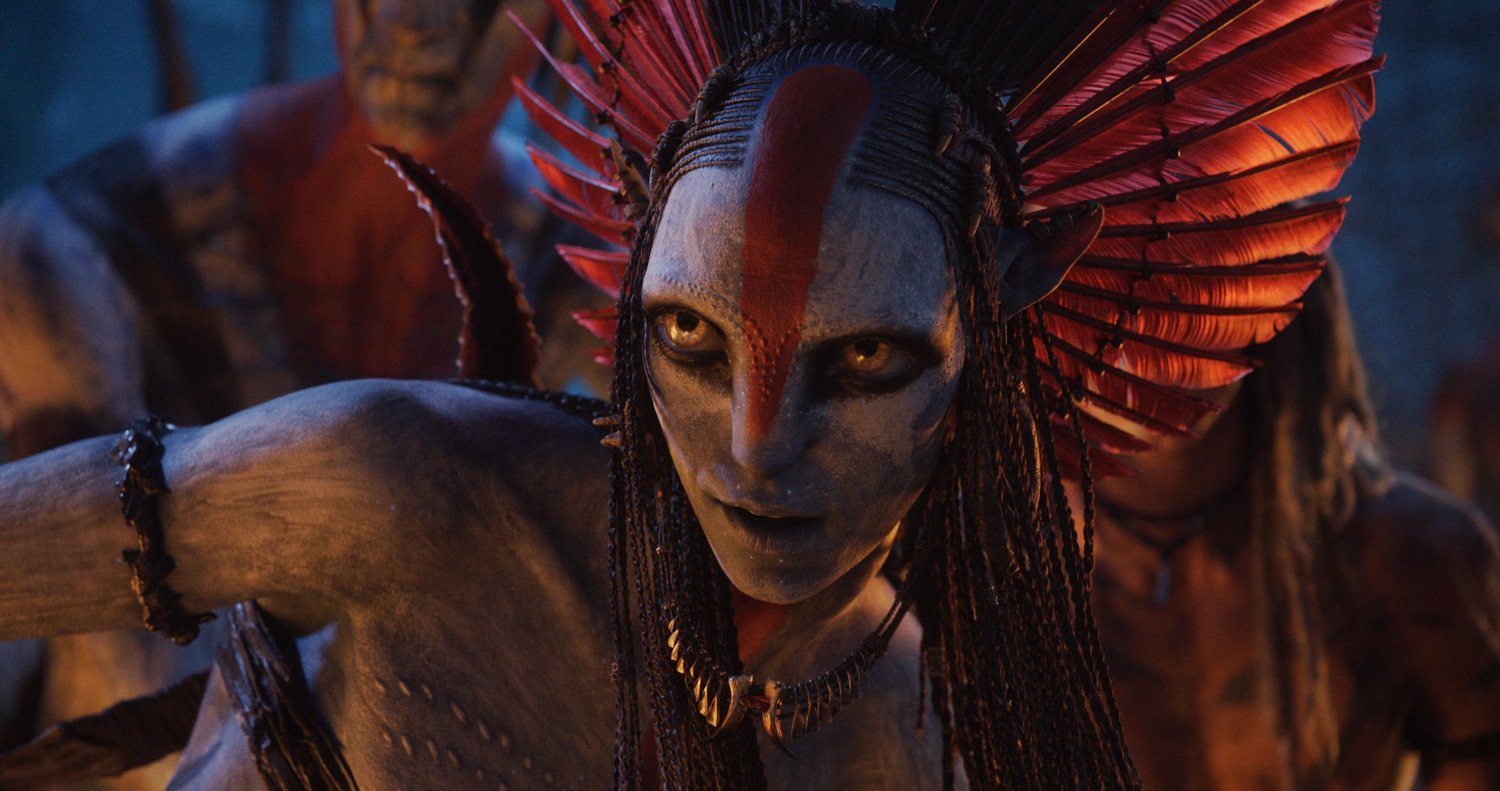
Instead of the resource-raping RDA bringing the thunder to the Omatikaya and Metkayina first in Avatar: Fire and Ash, it’s another cross-section of the Na’vi. Cast off generations ago to live in an ashen volcanic ruin, the feral and airborne Mangkwan clan arrives to make their presence known. Controlled by the warlock enchantress Varang (Oona Chaplin of Game of Thrones, slinking and stalking provocatively through the digital performance capture makeup), they are disrupting the peace and attracting the alliance-seeking attention of Quaritch on his mission to apprehend the traitorous fugitive Jake and the indoctrinated Spider.
LESSON #3: MIRED IN REDUNDANCY— For the second film in a row, our blended refugee family is on the run, babysitting Spider, and questioning the overarching existence of Eywa as they debate whether to “bring a prayer to a gunfight.” Within that strife and doubt, Quaritch is still in one-track-mind vendetta mode on their heels and bringing the pesky humans with him. Different parts of the family are separated or captured for a time, leading to elaborate parental rescue efforts, culminating in a climactic massive sea battle where their aquatic friends are called upon to save the day with a suspenseful last-minute entry of reinforcements. If this very writer were lazy, sarcastic, and unprofessional, he could copy the plotted course from his Avatar: The Way of Water review, use a dash or two of the strikethrough font feature to switch and update a few names and places, and end up at the same place for Avatar: Fire and Ash.
Granted, every principal player has their miniature arc to advance from Avatar: The Way of Water, as detailed in Lesson #2. This includes singling out Spider as a bit of a targeted linchpin when an Eywa-powered rescue from Kiri changes his human physiology to be able to breathe the toxic Pandora air, something that—in the hands of the warmongering humans—would level the playing field. Similarly, the introduction of Varang and her Mangkwan warriors in Avatar: Fire and Ash represents a villainous dichotomy from the positive friendship growth cultivated throughout the entire second movie with the Metkayina, and provides a new palette of textures and hues for the visual effects departments to play with in majestic 3D.
As aforementioned, James Cameron can sell simple tales wrapped in compelling, jaw-dropping grandeur, but this overall chapter of Avatar: Fire and Ash feels far too redundant. The potential of each of those individual arcs—stretched for what they are by assisting writers Rick Jaffa and Amanda Silver from the excellent Planet of the Apes reboot series—is trapped in an amusement park ride that demands the same jungle excursion pitfalls, machine gun destruction, silly mano-y-mano showdowns, and an amphibious grand finale that we have already seen before. All of that dazzles once, but not twice, in this day and age.
The painful survivor’s guilt angle alone should have elevated Sam Worthington and Zoe Saldaña—who both took a commanding step forward once already from Avatar to Avatar: The Way of Water, with the added family dynamic—to take this movie over with increased concentrations of their fortress of strength, duty, and valor that started this fantastical franchise’s
magic in the first place. They are too often pushed aside. Woefully, Stephen Lang’s exhausting revenge tour steals the sizzling oxygen from what could have been (and should have been) a more raw and compelling storyline of inter-Na’vi conflict with the infusion of Varang’s wicked ways. Cameron and company have this perfectly dominant and visually interesting presence to take over as the primary antagonist and blow it. Likewise, Avatar: Fire and Ash is a movie where the humans—who have had their asses handed to them twice and still don’t learn—get in the way and perpetuate more unnecessary ecological torture porn when they should have been off-screen entirely (especially if Cameron is spinning as many as four more films after this one), licking their wounds, regrouping, and lurking while the natives splinter from possible disunion.
LESSON #4: FAILING TO MAKE US CARE— In the end, Avatar: Fire and Ash is still force-feeding more myth into Pandora when there was already plenty of deeply in place. Because this film regurgitates Quaritch and his apparent nine lives, and pretends to place consequence on the borderline-useless “bro” Spider, we simply fail to care. This is especially the case when it is packaged the same and ends with very little net character gain after another three hours spent chasing aliens and absorbing repetitive environmental and colonization parallel commentary. Where James Cameron previously succeeded in his lengthy epics was when scripts were flipped at some point to shift power dynamics and emotional anchors dramatically. Look no further than the leap and advancement from The Terminator to T2. Shockingly, a copy machine was used in place of a springboard, and the disappointing storytelling results show—no matter how pretty it all looks. Three years ago, in this review space covering Avatar: The Way of Water, respect was paid to James Cameron for being less-than-properly heralded as “one of the best cinematic storytellers for action and emotion the medium has ever seen” and someone who “has crafted some of the most elaborate, dazzling, and iconic action sequences for decades now.” Looking over all of his career’s creations from Terminator to Titanic and beyond to his Pandora universe returning in Avatar: Fire and Ash, those weren’t light words. Like him or not, he’s in rarefied air and has earned his massive success and esteem.
LESSON #1: MAKE US CARE— Circle back for a moment to his capacity as an emotional cinematic storyteller. Through all of James Cameron’s foremost technical prowess to deliver the fantastical, he has always found a way to make us care about simple tales underneath the flashy presentation. Through two Avatar movies, he achieved that very pull, even against the Pocahontas, Dances With Wolves, and Ferngully: The Last Rainforest comparisons and criticisms. Unfortunately, that undaunted magnetism ends with Avatar: Fire and Ash. At nine hours and change into a saga daring to be a generational story that could stretch as long as seven films in the next decade, James Cameron has failed to make us care.
Compared to the 16-year storyline gap between the original and its first sequel, Avatar: Fire and Ash positions itself as a direct follow-up to Avatar: The Way of Water. It takes place a year after the tragic battlefield death of Neteyam, the oldest son of Omatikaya clan leaders Jake Sully (Sam Worthington) and Neytiri (Zoe Saldaña). The loss of a child still weighs heavily on the family as they have accepted the invitation to remain with the seafaring Metkayina people, led by Tonowari (Cliff Curtis) and the now-pregnant Ronal (Kate Winslet). Tranquility is tenuous, as the elders know it’s a matter of time before the invasive earthlings of the RDA will mount another offensive to conquer the planet for their financial gain.
LESSON #2: MAXIMUM SURVIVOR’S GUILT— While the death of their son has scarred the married hearts of Jake and Neytiri, the member of the Sully family hit hardest by the tragedy is Neteyam’s younger brother, Lo’ak (Britain Dalton of Dark Harvest). He is the narrator of Avatar: Fire and Ash, and his purview feels a heavy measure of blame for his brother’s death. The festering disdain is made worse by how hard his father pushes him to take his brother’s place and act more responsibly and redemptively to protect the family. The survivor’s guilt also eats at his adopted sister, Kiri (Sigourney Weaver), trying to better connect with her latent spiritual powers and Spider (Scream VI’s Jack Champion), the adopted human tagalong who is the biological son of the Na’vi-resurrected Col. Miles Quaritch (Stephen Lang), the sworn enemy of Jake Sully.
Instead of the resource-raping RDA bringing the thunder to the Omatikaya and Metkayina first in Avatar: Fire and Ash, it’s another cross-section of the Na’vi. Cast off generations ago to live in an ashen volcanic ruin, the feral and airborne Mangkwan clan arrives to make their presence known. Controlled by the warlock enchantress Varang (Oona Chaplin of Game of Thrones, slinking and stalking provocatively through the digital performance capture makeup), they are disrupting the peace and attracting the alliance-seeking attention of Quaritch on his mission to apprehend the traitorous fugitive Jake and the indoctrinated Spider.
LESSON #3: MIRED IN REDUNDANCY— For the second film in a row, our blended refugee family is on the run, babysitting Spider, and questioning the overarching existence of Eywa as they debate whether to “bring a prayer to a gunfight.” Within that strife and doubt, Quaritch is still in one-track-mind vendetta mode on their heels and bringing the pesky humans with him. Different parts of the family are separated or captured for a time, leading to elaborate parental rescue efforts, culminating in a climactic massive sea battle where their aquatic friends are called upon to save the day with a suspenseful last-minute entry of reinforcements. If this very writer were lazy, sarcastic, and unprofessional, he could copy the plotted course from his Avatar: The Way of Water review, use a dash or two of the strikethrough font feature to switch and update a few names and places, and end up at the same place for Avatar: Fire and Ash.
Granted, every principal player has their miniature arc to advance from Avatar: The Way of Water, as detailed in Lesson #2. This includes singling out Spider as a bit of a targeted linchpin when an Eywa-powered rescue from Kiri changes his human physiology to be able to breathe the toxic Pandora air, something that—in the hands of the warmongering humans—would level the playing field. Similarly, the introduction of Varang and her Mangkwan warriors in Avatar: Fire and Ash represents a villainous dichotomy from the positive friendship growth cultivated throughout the entire second movie with the Metkayina, and provides a new palette of textures and hues for the visual effects departments to play with in majestic 3D.
As aforementioned, James Cameron can sell simple tales wrapped in compelling, jaw-dropping grandeur, but this overall chapter of Avatar: Fire and Ash feels far too redundant. The potential of each of those individual arcs—stretched for what they are by assisting writers Rick Jaffa and Amanda Silver from the excellent Planet of the Apes reboot series—is trapped in an amusement park ride that demands the same jungle excursion pitfalls, machine gun destruction, silly mano-y-mano showdowns, and an amphibious grand finale that we have already seen before. All of that dazzles once, but not twice, in this day and age.
The painful survivor’s guilt angle alone should have elevated Sam Worthington and Zoe Saldaña—who both took a commanding step forward once already from Avatar to Avatar: The Way of Water, with the added family dynamic—to take this movie over with increased concentrations of their fortress of strength, duty, and valor that started this fantastical franchise’s
magic in the first place. They are too often pushed aside. Woefully, Stephen Lang’s exhausting revenge tour steals the sizzling oxygen from what could have been (and should have been) a more raw and compelling storyline of inter-Na’vi conflict with the infusion of Varang’s wicked ways. Cameron and company have this perfectly dominant and visually interesting presence to take over as the primary antagonist and blow it. Likewise, Avatar: Fire and Ash is a movie where the humans—who have had their asses handed to them twice and still don’t learn—get in the way and perpetuate more unnecessary ecological torture porn when they should have been off-screen entirely (especially if Cameron is spinning as many as four more films after this one), licking their wounds, regrouping, and lurking while the natives splinter from possible disunion.
LESSON #4: FAILING TO MAKE US CARE— In the end, Avatar: Fire and Ash is still force-feeding more myth into Pandora when there was already plenty of deeply in place. Because this film regurgitates Quaritch and his apparent nine lives, and pretends to place consequence on the borderline-useless “bro” Spider, we simply fail to care. This is especially the case when it is packaged the same and ends with very little net character gain after another three hours spent chasing aliens and absorbing repetitive environmental and colonization parallel commentary. Where James Cameron previously succeeded in his lengthy epics was when scripts were flipped at some point to shift power dynamics and emotional anchors dramatically. Look no further than the leap and advancement from The Terminator to T2. Shockingly, a copy machine was used in place of a springboard, and the disappointing storytelling results show—no matter how pretty it all looks.
LOGO DESIGNED BY MEENTS ILLUSTRATED (#1360)