

Images courtesy of A24
MARTY SUPREME— 3 STARS
With the spine of a sports movie, the maniacal misadventure Marty Supreme from director Josh Safdie invites and pushes viewers to get into a tizzy, more or less, over ping pong. For film aficionados with simpler tastes than finery produced by A24, there’s a good chance they haven’t seen ping pong depicted this much on the big screen since the 2007 oddball comedy, Balls of Fury. Holy macaroni, other than securing ping pong consultant Diego Schaaf, Marty Supreme is far from that lemon, and is filled with the kinds of harsh personas and agitated tension that would squish an entire bushel of lemons without wincing.
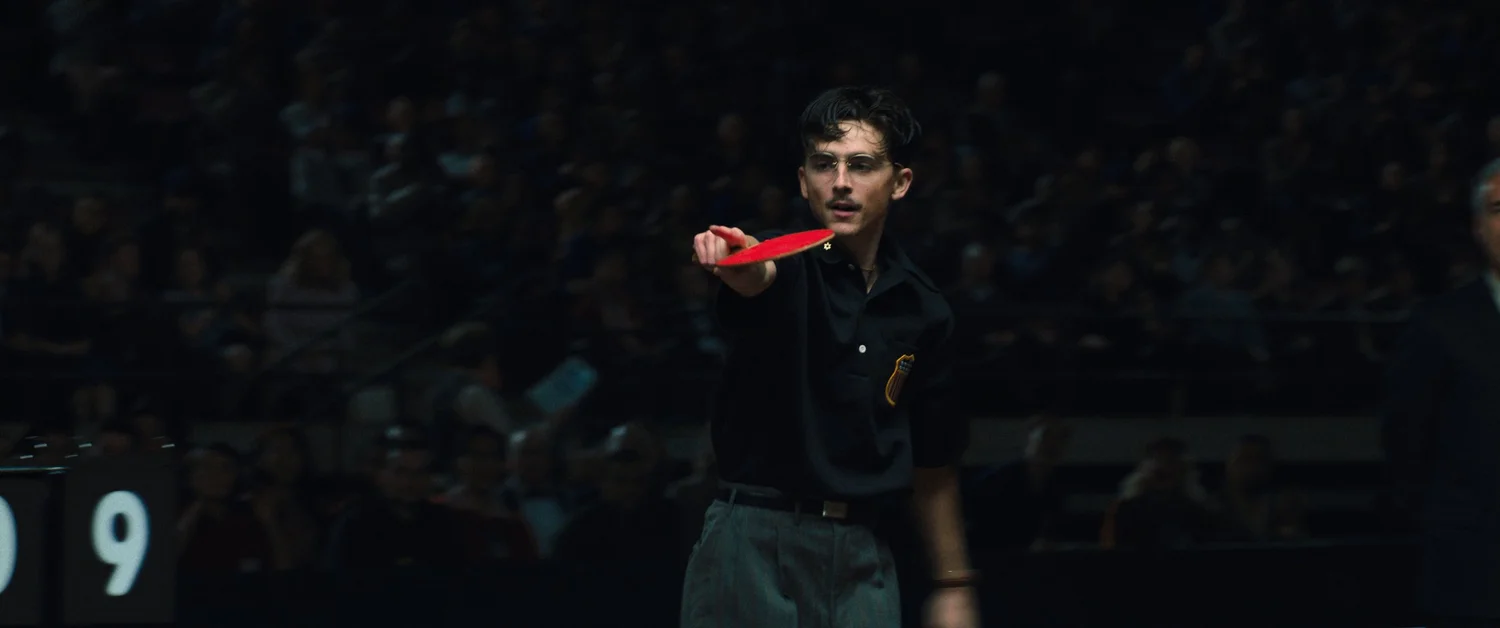
Harsh and agitated, you ask? Yes, and here’s an example. According to the title character of Marty Supreme, we’re naming the sport wrong right off the bat. In a running gag not overtly hilarious on the level of something found in a Naked Gun movie but effective to get eye-rolling chuckle, every time the name “ping pong” is spoken to Timothée Chalamet’s Marty Mauser, he offhandedly corrects the confronted person with crude prissiness to call the sport its proper name of “table tennis.”
When he does it, Marty is perturbed and petulant because he sees the majority of people not taking his chosen passion seriously. He zips right past passive-aggressive whining to in-your-face indignation as quickly as his drop shot. The behavior brewing—which only gets more irrational and deranged as the movie goes on—creates another cinematic litmus test for Marty Supreme when it comes to embracing the prescribed tizzy.
We have to find a way to root for an asshole. Worse, depending on your own contempt or adoration for the debate of formality of table tennis versus ping pong, we have to root for an asshole playing that predominantly inconsequential sport. Pin that for later.
Loosely inspired by the flamboyant former table tennis champion Marty Reisman, Marty Supreme is set in 1952, where the self-proclaimed best American champion of table tennis is languishing in the Lower East Side of New York City, living with his old biddy mother (Fran Drescher, criminally underused in a comeback role) and laboring at a shoe store run by his uncle. After banging and—complete with a Look Who’s Talking!-style opening credits sequence—impregnating his married paramour, Rachel Mizler (2025’s very busy Odessa A’zion), in the storeroom, Marty lifts the money owed to him from the store safe and flies to London for the British Open, expecting to win and be pampered like a champion professional athlete.
LESSON #1: OVERCONFIDENCE PERSONIFIED— Mary Mauser sees himself to be uniquely positioned to become America’s first superstar of the sport, with the potential to fill stadiums, and pitches his greatness to anyone who will listen and anyone who can elevate his status. A proud Jew, he takes it a step too far, calling himself “the ultimate product of Hitler’s defeat.” At 23, Marty has branded his own table tennis ball and hopes to market the first high-visibility orange ball. In London, he verbally tears down his competition and weasels his way into the wandering eye, good graces, and illicit bedsheets of Kay Stone (Oscar winner Gwyneth Paltrow), a retired movie star and trophy wife to inkpen magnate Milton Rockwell (Shark Tank’s Kevin O’Leary, planted as the domineering villain).
When Marty loses in the British Open final to the unflappable post-war Japanese champion Koto Endo (real-life deaf Olympian Koto Kawaguchi), he refuses to accept his defeat and declining circumstances. After taking entertainment money beneath his standards by working as vaudeville halftime and pre-game entertainment for the Harlem Globetrotters basketball team with fellow champ Béla Kletzki (the overqualified Géza Röhrig from Son of Saul), he returns to New York City, heartset on making the trip to Japan for the world championship and a rematch with Endo.
This is where Marty Supreme and Josh Safdie flip the proverbial big switch from the old Frankenstein set and jolt this movie to a different voltage level of electricity, and it starts with being handcuffed in his mother’s apartment, wrapped in a towel from the shower. After a daring fire escape chase with little else but the shirt on his back, Marty goes on the run with a mission to scrap together the necessary money and evade the law. Taking a page from last year’s Best Picture winner, Anora, which stopped its steady passage of time for a combative “one wild night” escapade, the massive and arduous middle of Marty Supreme becomes a turbulent comedy of errors and a tawdry cavalcade of lucky breaks.
LESSON #2: THE DEPTHS ONE WOULD STOOP FOR THEIR OWN GAIN— The longer and weirder the odyssey careens in Marty Supreme, the more shocking the litany list of sins, fuckups, and indiscretions becomes. For our main character, all of it tests the Top Gun line of “Son, your ego is writing checks your body can’t cash.” Continuing into James Tolkan’s fiery chew-out monologue, there’s admittedly a thrilling point in Marty Supreme, watching it spew its narrative guts of pitfalls all over the place, where we, the viewer, fall in line like Goose to answer “Thank you, sir” to the interjection of “And you, asshole, you’re lucky to be here.” Marty Supreme indeed is an untamed plunge that has to be seen and weathered to believe (something this review refuses to spoil further).
LESSON #3: ROOTING FOR THE ASSHOLE— With each new despicable and desperate act committed by Marty, inflicting selfish collateral damage to others around him, his foolhardy pride becomes more incorrigible. His collective impatience for money, dreams, and respect is huge. Compared to most sports movie tropes presenting emerging giants among men, romantic depictions of universally embraced sports, or, at the very least, lovable losers we can relate to, Marty Supreme gives us a “hero” who is reprehensible, through and through. As aforementioned, we somehow have to root for that guy or, contrarily, any measure of well-deserved comeuppance. How you find yourself cheering—or adamantly not—in Marty Supreme is crucial to the experience and will almost certainly split the theater patrons.
Deemed the hero or his own villain, Timothée Chalamet chisels an unforgettable scoundrel of a specimen in Marty Supreme, striding that fine line between complete hate and wow-level talent. Through posture, gait, swirls of hair, beads of sweat, and devious grins on top of table tennis chops, the Wonka and Dune franchise star invents a singular personality of a narcissistic champion mired with the path of a loser so warped and wound differently than everyone else in the movie that his performance leaps off the screen. He and his tailspin are spellbinding, all ominously backed by an aggressive musical score from synthesizing Uncut Gems composer Daniel Lopatin and tone-setting, on-the-nose soundtrack pulls from the 1980s.
Those infusions, coupled with edgy camera work from cinematographer and two-time Oscar nominee Darius Khondji, attempt to enliven the striking period detail of the production and engineer a big game feel rocketing towards a finale. In doing so, Marty Supreme can be as frenetic as its lead, and those brazen balls are what people come for with a Safdie film. There’s an energy—an intoxicating and exhausting fix—to hitchhiking on this downward spiral. However, when it’s all said and done in this male-dominated affair, you’re back to scrounging for or justifying the satisfaction or dissatisfaction of Lesson #3 and the fact that this is, once again, a tizzy made for ping pong.
LOGO DESIGNED BY MEENTS ILLUSTRATED (#1358)